Grow Shopify revenue on the traffic you already have: a no-new-ad-spend plan
Most of the money a Shopify store loses leaks out after the click. Fix the leaks before you raise the ad budget.
Contents
- Why a bigger ad budget rarely fixes the problem
- The five numbers that decide your revenue
- Find the leaks first
- Convert more of the visitors you already have
- Recover carts and checkouts
- Raise order value without giving margin away
- Turn first orders into second orders
- Cut failed COD orders without scaring buyers
- Build channels you own
- Measure money, not messages
- A 30-day plan
- Frequently asked questions
- How LoopChat helps
You can grow a Shopify store's revenue without a bigger ad budget by earning more from the visitors and customers you already have: convert more of today's traffic, win back abandoned carts and checkouts, lift the average order value, stop losing cash-on-delivery orders at the doorstep and bring first-time buyers back for a second order. None of this replaces acquisition. It makes every rupee you already spend on acquisition work harder.
Why a bigger ad budget rarely fixes the problem
Paid traffic tends to get more expensive as a category fills up with sellers chasing the same buyers. Doubling spend on a store that converts poorly simply buys twice as many people who leave.
Look at where the money actually disappears. A shopper in Indore clicks your ad, browses three kurtas, adds one to the cart, reaches checkout, sees a delivery charge and closes the tab. Another places a COD order and refuses the parcel. A third buys once and never hears from you again. The ad did its job in all three cases. The loss happened afterwards, and fixing those steps usually costs less than outbidding competitors for the next click.
The five numbers that decide your revenue
Before changing anything, get clear on the levers. Revenue moves when one of these moves.
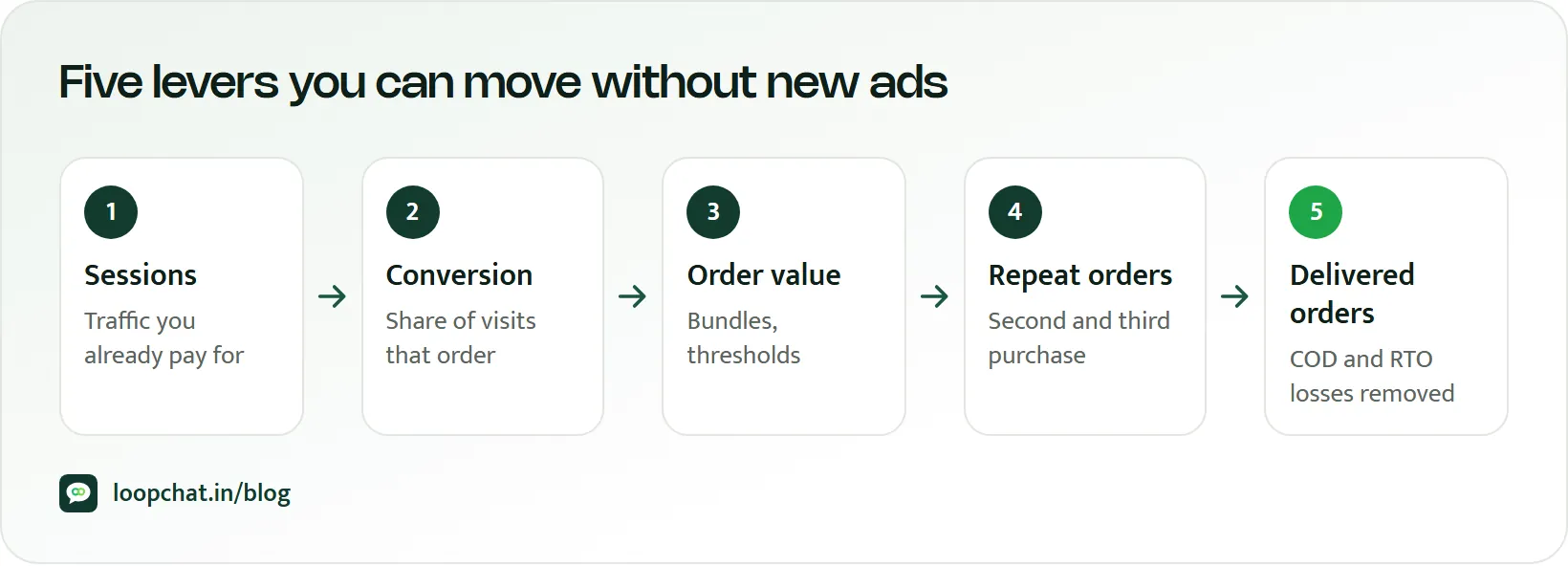
| Lever | What it measures | How you move it |
|---|---|---|
| Conversion rate | Share of visitors who buy | Better product pages, simpler checkout |
| Average order value | Rupees per order | Bundles, add-ons, shipping thresholds |
| Purchase frequency | Orders per customer per year | Reminders, win-backs, loyalty |
| Lifetime value | Total margin from one customer | Frequency and order value together |
| Revenue per visitor | Conversion rate times order value | Track weekly as your headline number |
Find the leaks first
Map the journey and put a number on each drop-off.
- Product page exits. People view but never add to cart. Usually a missing answer: size, fabric, ingredients, delivery date.
- Cart abandonment. Items added, checkout never started. Often anonymous, so you can only reach them on-site or through ads.
- Checkout abandonment. Checkout started and contact details entered, but no payment. Higher intent, and reachable. We explain why these two need different handling in abandoned cart vs abandoned checkout.
- Failed COD orders. Orders that are shipped but refused or undeliverable, which cost you shipping both ways.
- No second order. The quietest leak, because nothing errors out. The customer simply never returns.
Convert more of the visitors you already have
Baymard Institute's running average across 50 studies puts online cart abandonment at about 70%. In its own survey of shoppers, the most common reason given (outside "just browsing") was extra costs such as shipping, tax or fees, followed by slow delivery, distrust of the site with card details, forced account creation and a long checkout. Those are survey results from Baymard's sample, not Indian data, but every one of them applies to an Indian store too. Our guide on how to reduce cart abandonment on Shopify goes through the fixes in order.
- Answer the obvious questions on the page. Size chart, material, shelf life for snacks, skin type for skincare, expected delivery to the shopper's pincode, and the return policy in plain words.
- Make mobile fast and checkout short. Do not force account creation. Ask only for what you need to ship.
- Show costs early. If there is a delivery or COD charge, say so on the product or cart page, not on the last screen.
- Earn trust. Reviews with photos, a real contact number and a visible returns policy matter more for a young D2C brand than for a marketplace listing.
- Offer the payment methods people expect. For most Indian shoppers that means UPI and, for many, cash on delivery.
Recover carts and checkouts
Once someone has shared a phone number or email at checkout, you can follow up. Run separate sequences for carts and checkouts, because a checkout abandoner often stopped for a specific reason: a shipping charge, a failed UPI payment, a pincode question. Our guide to Shopify abandoned cart recovery walks through a full sequence.
- Send the first reminder within the hour. Intent fades quickly.
- Use the channel people read. WhatsApp, email and SMS each have a place; for many Indian shoppers WhatsApp is where they reply. Remember that marketing messages need the customer's opt-in.
- Hold discounts back. Lead with help and a direct link back to the cart. Offer an incentive only in a later message, and skip it on high-value carts where margin matters more than speed.
- Give big carts a human. For a ₹12,000 lehenga order, a short personal reply from your team answering the fit question can do more than any automated nudge.
Raise order value without giving margin away
- Bundle things that belong together. A face wash, toner and moisturiser routine makes sense; a generic multi-buy discount on unrelated products rarely does. Shopify needs a bundles app installed to create bundles.
- Cross-sell what fits the cart. A phone case with a screen guard beats a generic bestseller strip.
- Ask after the purchase. The moment right after payment is high trust; a post-purchase app can offer a small, relevant add-on.
- Set a free-shipping threshold slightly above your current average order. Shopify's free shipping discounts can require a minimum purchase amount or item count. Check the threshold against real margin, not a round number.
- Use quantity breaks for consumables. Three packs of namkeen at a better per-pack price suits products people reorder anyway.
Turn first orders into second orders
- Make the post-purchase experience feel looked after. Order confirmation, shipping and delivery updates, plus one useful tip on using the product.
- Remind people when they are running out. Time replenishment messages to the real usage cycle of the product. More ideas in repeat purchase strategies.
- Win back based on silence, not the calendar. Trigger a message when a customer has gone quiet for longer than their usual gap. Our guide to Shopify customer retention covers the metrics and flows behind this.
- Treat your best customers differently. A customer on their fifth order should get early access or a thank-you, not the same blast as everyone else. See customer loyalty strategies.
- Recommend from history. Suggest the next product based on what they actually bought.
Cut failed COD orders without scaring buyers
On Shopify, cash on delivery is a manual payment method and those orders sit as pending until you mark them paid, so a refused parcel is pure loss.
- Confirm before dispatch. A one-tap WhatsApp confirmation is low friction and catches wrong addresses and impulse orders. Our guide on how to reduce COD failures goes deeper.
- Verify by risk. A first order from a new number to a new pincode deserves more checking than a returning customer's tenth order.
- Nudge towards prepaid. A small incentive to pay by UPI is often cheaper than a failed delivery.
- Follow up on failed deliveries. Contact the customer, reschedule if possible, and note patterns by pincode or courier. Our RTO reduction playbook goes further on returned parcels.
Build channels you own
Every customer you can message directly is one you do not have to pay to retarget.
- Collect opt-ins before people leave. Meta's rules require the person's number, a clear statement that they agree to hear from your named business, and compliance with local law.
- Segment by behaviour. Shopify customer segments are rule-based lists that update automatically as customers meet or stop meeting the criteria.
- Use WhatsApp for time-sensitive moments such as checkout recovery, COD confirmation and support.
- Use email for longer lifecycle content like guides and loyalty details that do not need an instant read.
Measure money, not messages
- Recovered revenue. Orders and rupees from recovery flows, not messages sent or opened.
- Repeat revenue. Tracked separately from first orders.
- By channel and segment. WhatsApp versus email, new versus returning, so a blended average does not hide a weak flow.
- Contribution margin. A workflow that costs more in discounts and messaging than it brings back is not working. Meta's WhatsApp charges are separate from any tool's plan; estimate them with the WhatsApp pricing calculator.
A 30-day plan
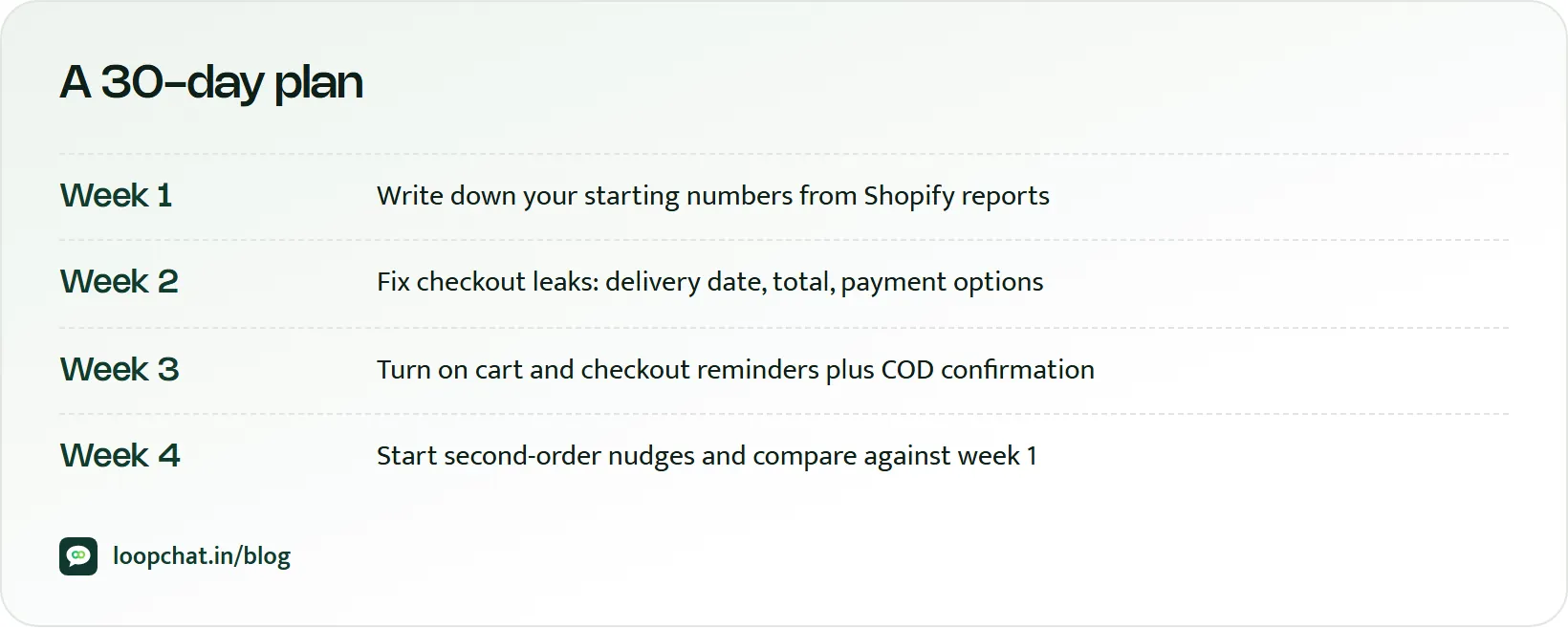
- Week 1: Write down where you start, using your own store data: how many visits turn into orders, how many checkouts are left unfinished, how many COD parcels come back and how many buyers have ordered twice.
- Week 2: Fix the biggest friction points: show costs earlier, trim checkout fields, add missing payment methods.
- Week 3: Launch checkout recovery and COD confirmation.
- Week 4: Once recovery runs cleanly, add replenishment reminders, win-backs and post-purchase cross-sells.
Frequently asked questions
### Can a Shopify store really grow while the ad budget stays flat? Work on what happens after the click. Improve product pages and checkout so more visitors buy, recover abandoned checkouts, raise order value with bundles and shipping thresholds, and bring first-time buyers back with timely reminders.
### Which fix usually pays back first? Checkout recovery is usually the quickest win because the shopper has already shown intent and shared contact details. For stores with a lot of cash-on-delivery orders, confirming COD orders before dispatch is equally fast.
### Why do cart and checkout reminders bring money back? They follow up with people who were close to buying, answer the question or fix the problem that stopped them, and send them straight back to their cart. That costs far less than finding a new buyer.
### What gets a first-time buyer to order again? Make the first delivery go smoothly, time reminders to how long the product lasts, message customers who have gone quiet, and give your most loyal customers something better than a generic campaign.
### Is a bigger basket always more profitable? Usually, yes. Shipping, packing, payment fees and acquisition cost are spread across a bigger basket, so each order keeps more margin, provided you are not buying the higher value with heavy discounts.
### How do Indian D2C brands lean less on paid traffic? Combine WhatsApp checkout recovery, COD confirmation and repeat purchase journeys, and grow an opted-in customer list you can message without paying for every touch.
How LoopChat helps
LoopChat connects to your Shopify or WooCommerce store and runs these workflows on the official WhatsApp Business Platform: abandoned cart and checkout reminders, COD order confirmation, order and shipping updates, and repeat purchase nudges. You can build your own journeys with triggers, waits and conditions in the no-code flow builder, and send broadcasts to tagged segments.
Replies land in a shared inbox where an AI agent answers in English, Hindi or Hinglish and hands over to your team in one click. Shopify connections start on the Sprint plan; revenue attribution reports are on the Turbo plan. See pricing for details.
To see it on your own store, start a 15-day free trial or book a demo.
Sources
- Baymard Institute: 50 Cart Abandonment Rate Statistics 2026 (accessed October 2026)
- Shopify Help Center: Manual payment methods (accessed October 2026)
- Shopify Help Center: Free shipping discounts (accessed October 2026)
- Shopify Help Center: Product bundles (accessed October 2026)
- Shopify Help Center: Customer segmentation (accessed October 2026)
- Meta for Developers: Get opt-in for WhatsApp (accessed October 2026)