Customer loyalty strategies for Indian D2C brands: tiers, VIPs, referrals and service
Loyalty is a customer choosing you when a cheaper option is one tap away. Here is how to design for that, not just for reminders.
Contents
Customer loyalty is not the same as a customer buying twice. A loyal customer picks your brand when a marketplace listing is cheaper and a competitor's ad is sitting right above yours. The strategies that build that preference are recognition, access, memory, service and a reason to tell friends, and this guide walks through each one with examples from Indian D2C stores.
What loyalty actually looks like in a D2C store
Picture a block-print kurta label in Jaipur. One customer in Indore orders every time a reminder lands in her WhatsApp. Another in Kochi checks the new drop page before anyone messages her, recommends the brand in her office group, and waits for a restock rather than buying a lookalike elsewhere.
Both are repeat buyers. Only the second one is loyal. The first is responding to good retention work: timely nudges and low friction. The second has a preference, and preference survives a price gap, a delayed parcel or a slow month without campaigns.
That distinction matters because the tactics are different. Reminders buy the next order. Loyalty strategies make the customer want the next order before you ask.
Six loyalty strategies that build habit and trust
1. Tiers a normal customer can actually reach
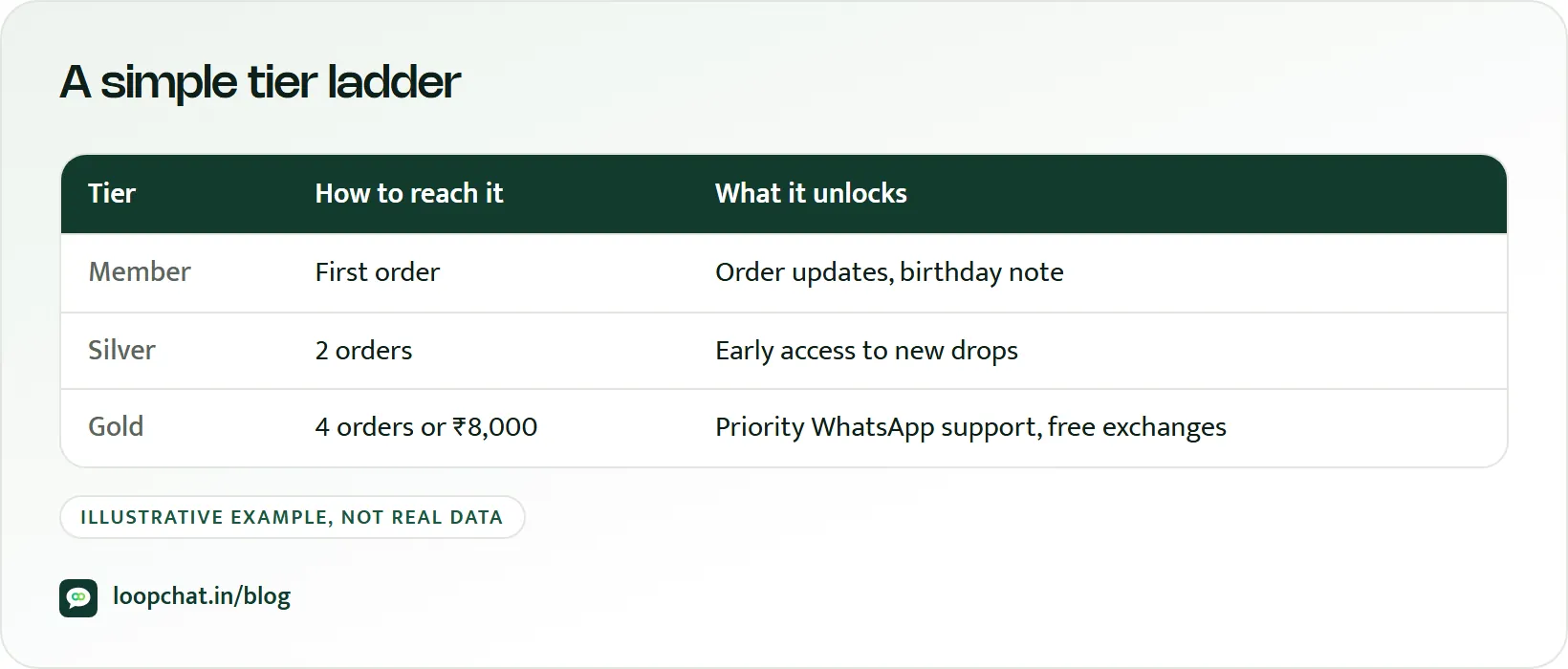
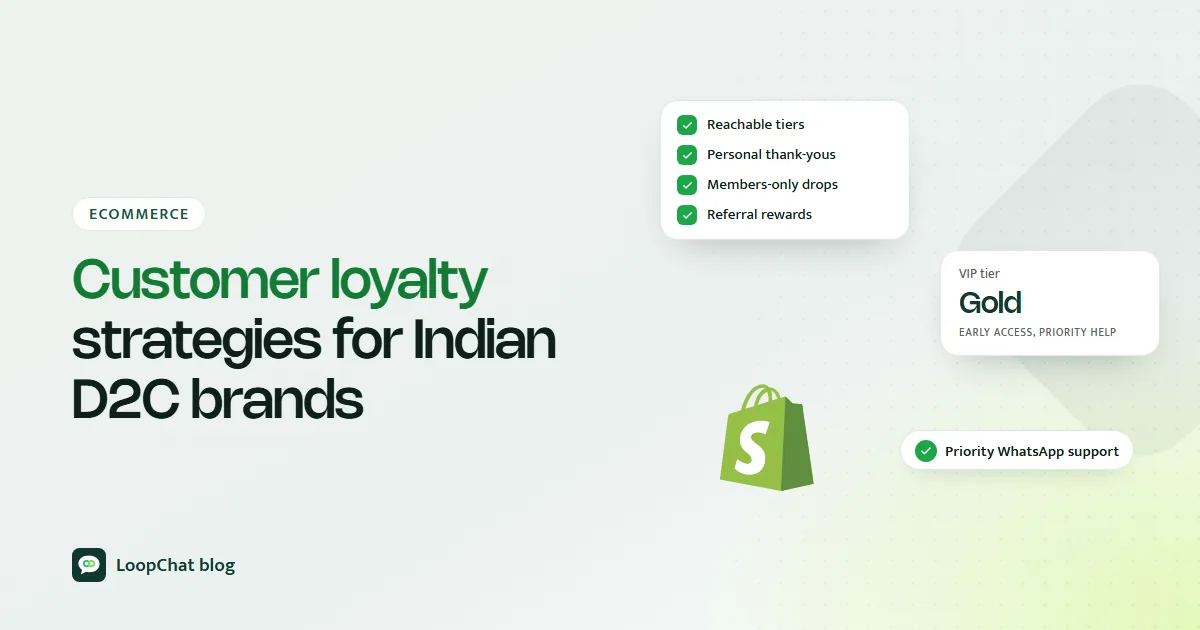
Tiered rewards work because they give customers a reason to keep their purchases with you instead of splitting them across three brands. Each level should come with something they notice: free shipping without a minimum, a birthday credit, first pick of limited prints.
The common error is setting the top tier where only a handful of people will ever arrive. If your typical customer orders twice a year at around the same basket size, design the first tier so they hit it within their second or third order. A tier nobody reaches is a tier that tells customers they are not important.
Keep it to two or three levels with names that mean something, and show people how close they are. "One more order to Gold" is a stronger nudge than any discount.
2. Access that money cannot buy elsewhere
Exclusive access signals that the relationship is worth more than the transaction. Useful forms for an Indian D2C brand:
- Early entry to a festive sale before it opens publicly
- First look at a new collection or flavour, with the option to reserve
- A members-only bundle that never appears on the website
- Restock alerts that go to loyal customers an hour before everyone else
Access costs you far less than a deep discount, and it does not train customers to wait for a price drop.
3. Treat your best customers differently, on purpose
VIP treatment is mostly tone and speed. Your top customers should hear from a named person, get replies faster, and occasionally receive something they did not expect: a handwritten note in the parcel, a free sample of the next launch, a quick message from the founder after their tenth order.
To find these people, you do not need a spreadsheet. Shopify's customer segment editor includes filters such as number of orders, amount spent and an RFM group filter (recency, frequency and monetary value), and its RFM report sorts customers into 11 predefined groups. A "Champions" or high-order-count segment is a ready-made VIP list.
4. Messages that prove you remember them
Generic promotions tell a customer they are a row in a database. A message that references what they actually bought tells them you know them. "The indigo dupatta you picked in March now comes in a matching kurta" lands differently from "New arrivals are live".
Personalisation does not need to be clever. Use the product they bought, the size they chose, the city they ship to, and the language they write to you in. A customer who messages in Hinglish should not get a stiff English reply.
5. Give advocates a reason and a link
Most brands already have customers who recommend them without being asked. A referral loop turns that into something you can measure: give each loyal customer a personal code or link, reward both sides (store credit for the referrer, a welcome offer for the friend), and send the code at a moment of happiness, such as right after a delivery is confirmed or a positive review is left.
Track referrals by code so you know which customers are your real advocates. Those people belong in your top tier, whatever their own spend.
6. Service is the loyalty programme nobody sees
The reference point for loyalty is often a bad moment handled well. A courier delay to a remote pincode, a wrong size, a damaged box of snacks: if you tell the customer before they ask, fix it quickly and do not make them repeat themselves, they remember it longer than any reward.
Practical habits: proactive delay messages (the same delivery updates at the heart of our playbook for reducing RTO), a single thread where the customer's order history is visible to whoever replies, and an easy exchange path. Our guide to Shopify CRM integrations covers how to put chats and orders in one place. Community helps here too. A small WhatsApp community or Instagram close-friends list for your most engaged buyers gives them early previews and a place to feel heard.
Loyalty and retention are not the same job
Retention is the operational layer: reminders, reorder timing, removing friction at checkout, win-back messages when someone goes quiet. Loyalty is the emotional layer that makes those mechanics work for longer. A loyal customer opens the reminder; an indifferent one blocks it.
Run both, but do not confuse them. If your only "loyalty" activity is a discount every 30 days, you are running retention with a margin problem. For the reorder side, see our guide to repeat purchase strategies that raise lifetime value, and for the operational setup inside Shopify, read Shopify customer retention.
Which channel carries which loyalty message
| Message | Best channel | Why |
|---|---|---|
| Tier upgrade, "you are close to Gold" | Short, personal, seen quickly | |
| Early access and restock alerts | Time-sensitive | |
| Monthly rewards summary | Room for detail and history | |
| Points or tier balance | On-site account page | Customer checks it themselves |
| VIP support conversations | Shared inbox | Full context for the agent |
For Indian shoppers, WhatsApp is where time-sensitive loyalty messages get noticed. It also comes with rules. Meta requires opt-in before you message someone, and the opt-in must clearly state your business name and that the person is agreeing to receive communication from you. Messages that promote offers are marketing templates (our guide to WhatsApp template approval explains the categories), and WhatsApp may limit how many marketing messages a person receives from all businesses based on their recent engagement. That is one more reason to send fewer, more relevant loyalty messages, and our guide to running a first broadcast without hurting your quality rating applies here too. Our WhatsApp marketing page covers the setup.
Four ways loyalty programmes quietly fail
- Points as the whole strategy. Points without recognition, access or good service feel like a coupon with extra steps.
- Everyone gets the same treatment. If a ten-order customer and a first-timer receive identical messages, the ten-order customer has no reason to feel special.
- Silence between purchases. Brands that only appear when there is a sale teach customers that every message is a pitch. Share care tips, styling ideas or behind-the-scenes notes in between.
- A programme that needs a manual. If a customer cannot explain your rewards in one sentence, or cannot redeem without contacting support, they will stop caring.
A one-page loyalty plan
- Write down which of your current activities are loyalty and which are retention reminders. Keep both lists.
- Create at least one reachable tier for frequent customers, with a perk they can feel.
- Use purchase history in every message to repeat customers.
- Add a referral code if customers already recommend you unprompted.
- Send time-sensitive loyalty messages on WhatsApp, with proper opt-in.
- Test the programme by explaining it to a friend in one sentence. If you cannot, simplify it.
How LoopChat helps
LoopChat does not run a points engine. It is the messaging and service layer around your loyalty programme. On the Sprint and Turbo plans it connects to Shopify and WooCommerce, so you can tag and segment customers, then send tier updates, early-access alerts and restock news to those segments as WhatsApp broadcasts using approved templates.
The shared inbox puts WhatsApp, Instagram and website chat in one place, with labels, notes and assignment, so VIP conversations can go straight to your best agent. AI agents answer routine questions in English, Hindi and Hinglish from your business information and hand over to a person in one click when a loyal customer needs a human. Plans and limits are on the pricing page. To see it with your own store, start a 15-day free trial or book a demo.
Sources
- Shopify Help Center: Shopify-based customer segment filters (accessed October 2026)
- Shopify Help Center: Customers reports (accessed October 2026)
- Meta for Developers: Get opt-in for WhatsApp (accessed October 2026)
- Meta for Developers: Per-user marketing template message limits (accessed October 2026)