Shopify customer retention: the metrics, flows and setup that bring buyers back
A working retention system for Shopify stores in India: what to measure in your admin, which flows to automate first, and where retention leaks.
Contents
- Three numbers that get confused
- Where customers slip away
- Measuring retention inside Shopify
- How one good order turns into many
- The post-purchase sequence
- Winning back quiet customers
- VIP and loyalty layer
- Replenishment for consumables
- Segments to build first
- Service and delivery are retention
- Building the system in Shopify
- KPIs to review every month
- Retention mistakes that cost the most
- A 7-day, 30-day and ongoing checklist
- Run it as a system
- How LoopChat helps
Shopify customer retention is the share of your buyers who come back, and it is built from a handful of reports, segments and automated messages rather than one big campaign. The work starts the moment the first order is placed, because the experience of that order decides whether there is a second. This guide covers what to measure in your Shopify admin, which flows to build first, and the mistakes that quietly drain repeat revenue.
Three numbers that get confused
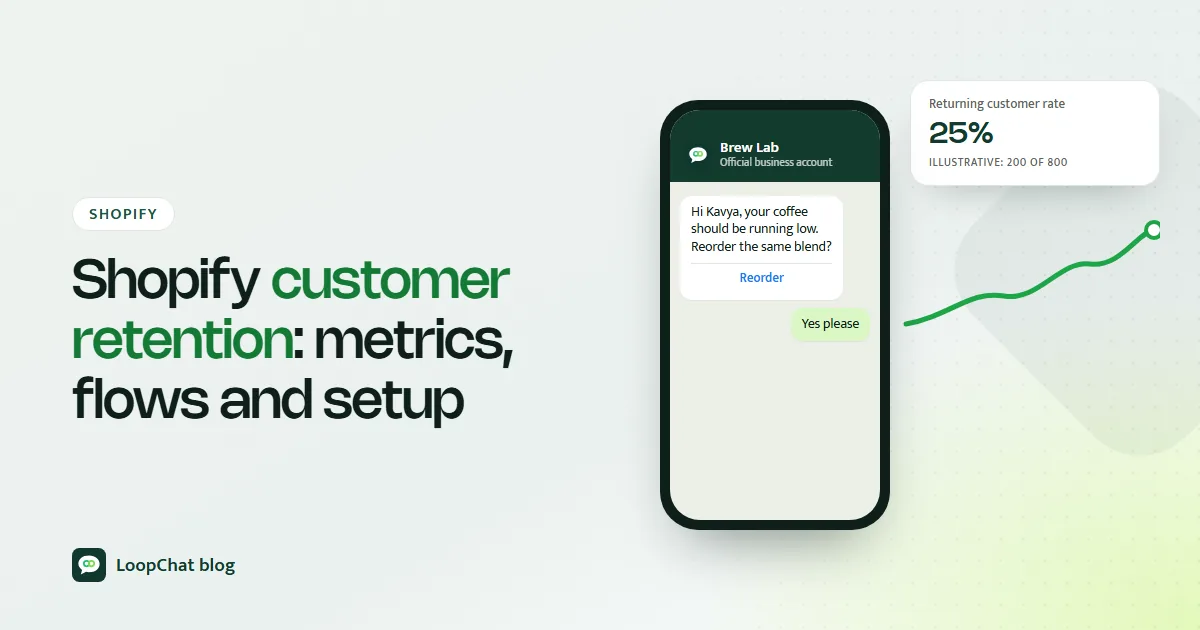
- Customer retention rate: of the customers who bought in one period, how many bought again in a later period. For example, if 800 customers ordered in January to March and 200 of them ordered again by June, that cohort's retention is 25%.
- Repeat purchase rate: the share of all your customers who have placed more than one order, over a window you choose.
- Customer lifetime value: the revenue (or margin) a customer brings over the whole relationship.
The first two say whether people come back; the third says what that is worth. All three matter more as ad costs rise, because repeat orders need no new acquisition spend. Our post on growing Shopify revenue without more ad spend shows where retention sits among the other levers.
What healthy retention looks like
Returning customers bring a steady share of monthly revenue outside sales, the repeat rate rises quarter on quarter, and lifecycle messages run without anyone remembering to send them.
Where customers slip away
- A one-time product. A wedding outfit is rarely rebought, so retention comes from related products and referrals.
- Silence after the order. The customer hears from you at checkout and then never again.
- No help using the product, and no reason to return. Poor results or nothing relevant means no second order.
- A bad support or delivery moment, such as a parcel stuck for days near a remote pincode.
Measuring retention inside Shopify
Shopify's customer reports cover most of this:
- Returning customers: everyone with two or more orders.
- Customer cohort analysis: groups customers by first-order date to show how each cohort keeps ordering.
- RFM customer analysis: scores customers on recency, frequency and monetary value and places them in 11 predefined groups.
- Predicted spend tier: shows the predicted value of customers in a cohort.
Track five metrics from these: repeat purchase rate, retention rate by cohort, purchase frequency (orders per customer per year), revenue per customer, and lifetime value split by acquisition channel and by segment.
How one good order turns into many
| Stage | What has to happen | Your main tool |
|---|---|---|
| First order to trust | Clear updates, on-time delivery | Order and shipping messages |
| Trust to second order | Good results, a timely nudge | Education and reminders |
| Second order to habit | Relevant suggestions | Segmented recommendations |
| Habit to loyalty | Feeling recognised | VIP perks and priority service |
| Loyalty to referrals | A reason to share | Referral codes |
The post-purchase sequence
Build this first. Timing follows events, not fixed dates:
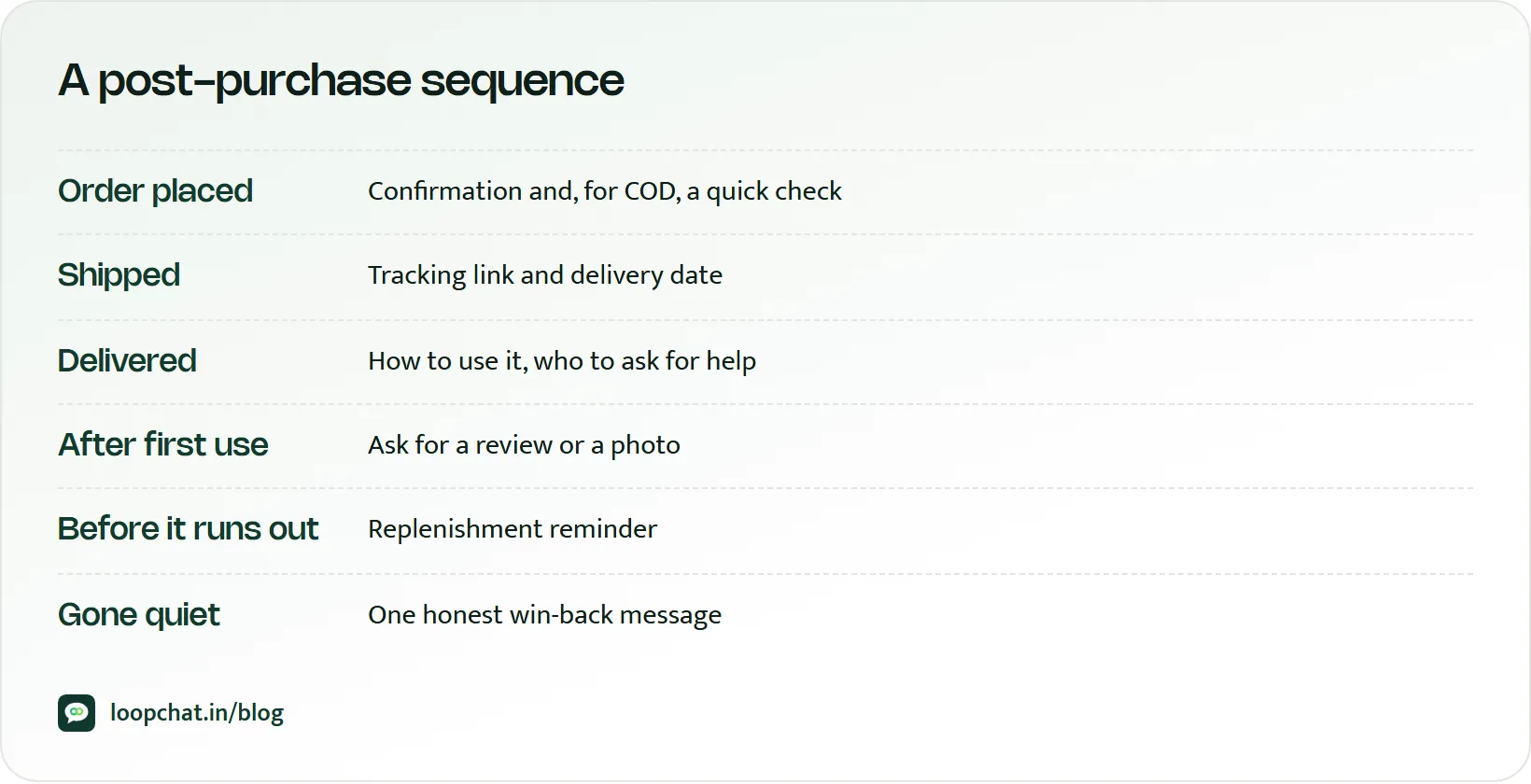
- On order: confirmation with what happens next. For COD orders, ask the customer to confirm, as set out in our guide to cutting COD failures.
- On dispatch: shipping update with tracking.
- A few days after delivery: how to use the product, one tip, one pairing idea.
- About a week later: a cross-sell based on what they bought.
- Around two weeks after delivery: a review request, which also reminds the customer of a good experience.
- When they pass their expected reorder point with no order: hand over to the win-back flow.
On WhatsApp, keep steps 1 and 2 free of offers. Meta classes an order confirmation or shipping update as a utility template only when it is non-promotional; an order update with a promotion counts as marketing. Our guide to getting WhatsApp templates approved explains the categories.
Winning back quiet customers
Use the cohort report to see when returning customers usually come back, and trigger win-back just after that point.
Split lapsed customers by order count, recency and total spend: a quiet three-order customer deserves a personal note.
A good win-back message has four parts: a personal greeting, a mention of what they bought, a relevant reason to come back (a restock, a new variant, a fixed problem), and an easy, low-pressure call to action. Hold the discount for the last message, not the first. For long-dormant customers, send a "we miss you" note, then a recommendation based on their last order, and finally a message saying you will stop writing unless they want to hear from you.
VIP and loyalty layer
Points, perks and exclusive access do different jobs, so layer them: points for everyday purchases, perks like free shipping for higher tiers, early access for the top. Two or three tiers with clear thresholds are enough. Experience rewards (early launches, a note from the founder, an invite to a store event in your city) often mean more than discounts.
Give top spenders their own VIP flow with priority replies and first access. Programmes fail when rewards are too small, rules are too complex, points expire unnoticed, members cannot see their progress, or the programme is treated as a marketing gimmick. Our post on customer loyalty strategies goes deeper.
Replenishment for consumables
Reminders suit skincare, supplements, pet food, household essentials, coffee and snacks, and baby products. Estimate how long a pack lasts, check it against real reorder gaps, then send a short sequence: a reminder before it runs out, a follow-up a few days later, and a final nudge (optionally with a small incentive) near run-out. Our guide to repeat purchase strategies and LTV works through the arithmetic.
Subscriptions suit customers who want zero effort; reminders suit those who want control. Offering both covers more people.
Segments to build first
Shopify's segment editor has filters for number of orders, amount spent, first and last order date, products purchased, an RFM group filter, and a predicted spend tier filter (available once your store has made more than 100 sales). Start with:
- First-time buyers in the last 30 days
- Customers with three or more orders
- Buyers of a specific consumable, by last order date
- At-risk or dormant RFM groups
A message to "everyone" is the wrong message for most of the list.
Service and delivery are retention
Fast replies win second orders. Proactive delivery messages reduce anxious "where is my order" chats and help cut returns to origin; see how to reduce RTO in Shopify stores. Make exchanges easy, describe products accurately and warn about delays before customers ask. The biggest leak is the gap between the first delivery and your next useful message.
Building the system in Shopify
You need four things: automated email, WhatsApp (and SMS if you use it), a shared inbox for support, and a retention dashboard. Shopify already holds the data: order history, frequency, last order date, spend and products bought. Shopify Flow, a free app on the Basic, Grow, Advanced and Plus plans, can tag customers automatically when they cross an order-count threshold. When your team also needs chats, pipelines and order history in one view, our guide to Shopify CRM integrations covers what to connect first.
| Channel | Best used for |
|---|---|
| Long education, loyalty summaries, slower win-backs | |
| Delivery updates, replenishment, time-sensitive offers, high-value win-backs | |
| SMS | Delivery-day alerts, very short prompts |
| Shared inbox | Support conversations with order context |
Automate in this order: post-purchase sequence, replenishment, win-back, VIP. Our list of Shopify workflows worth automating shows how these fit alongside cart recovery and COD confirmation. A lean team sets these up once, then needs a regular slot to monitor and test variants. And remember Meta's opt-in rule: before messaging on WhatsApp, the customer must have agreed to receive communication from your named business.
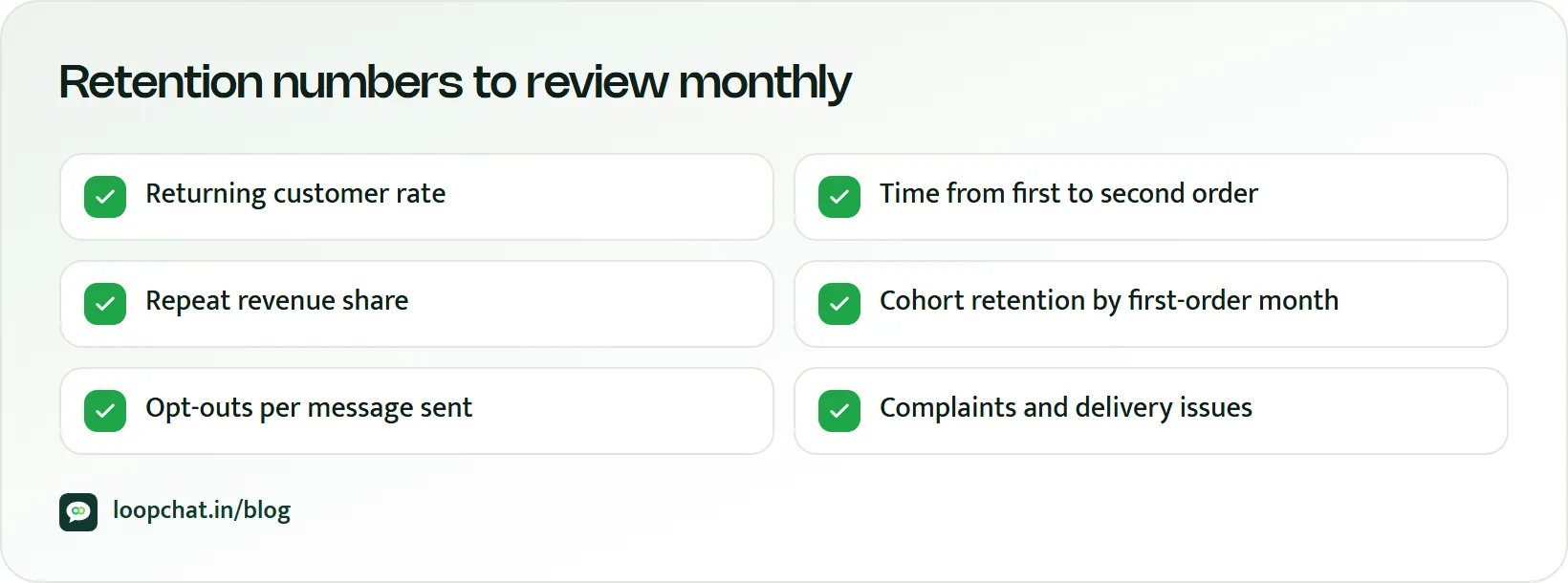
KPIs to review every month
- Baseline repeat purchase rate, and its change
- Revenue from returning customers
- Retention rate by cohort
- Revenue per customer
- Incremental lift from retention flows, measured against a holdout group that did not receive them
Retention mistakes that cost the most
- Discounting every repeat order, which trains customers to wait.
- Treating everyone the same.
- Starting win-back too late, after the customer has switched.
- Skipping education.
- Measuring opens instead of revenue.
A 7-day, 30-day and ongoing checklist
First 7 days: order confirmation, shipping and delivery messages, an education message, and phone number collection at checkout with clear consent.
First 30 days: cross-sell, review request, replenishment reminders, a win-back trigger and your core segments.
Ongoing: review repeat rate monthly, cohort retention quarterly, adjust win-back timing, test message variants, track returning-customer revenue, and keep the VIP flow running.
Run it as a system
Retention is not a Diwali-week campaign. It is a set of flows that run daily and get measured monthly, and the repeat buyers it creates are the base of profitable growth.
How LoopChat helps
LoopChat connects to Shopify and WooCommerce on the Sprint and Turbo plans and runs the WhatsApp side of retention: order and shipping updates, COD order confirmation, abandoned checkout reminders and reorder nudges, all built in a no-code flow builder with triggers, waits and conditions. Segments and tags drive targeted broadcasts, and the Turbo plan adds A/B split journeys and revenue attribution reports. More on our ecommerce page.
The shared inbox joins WhatsApp, Instagram and web chat, and AI agents answer in English, Hindi and Hinglish before handing over to a person. Compare plans on the pricing page, then start a 15-day free trial or book a demo.
Sources
- Shopify Help Center: Customers reports (accessed October 2026)
- Shopify Help Center: Shopify-based customer segment filters (accessed October 2026)
- Shopify Help Center: Shopify Flow (accessed October 2026)
- Meta for Developers: Template categorization (accessed October 2026)
- Meta for Developers: Per-user marketing template message limits (accessed October 2026)
- Meta for Developers: Get opt-in for WhatsApp (accessed October 2026)