How to reduce cart abandonment on Shopify: fix the leaks before you chase the carts
Most abandoned carts start with a fixable problem on your own store. Here is how to find it, fix it, and follow up with the shoppers who still leave.
Contents
- How big the problem is
- Why shoppers leave
- Find the exact stage where people leave
- Fix 1: say the delivery cost and date early
- Fix 2: make checkout short and account-free
- Fix 3: show trust and the payment methods Indians use
- Fix 4: no surprises in the final total
- Offers that help instead of training discount-hunters
- Follow up on WhatsApp, briefly
- Habits that keep working
- Frequently asked questions
- How LoopChat helps
Most Shopify stores lose the majority of their carts, and the biggest share of that loss comes from things on your own site: a surprise delivery charge, a forced login, a missing UPI option. To reduce cart abandonment on Shopify, find the exact step where shoppers drop off, fix the cost, checkout and trust problems there first, then send one or two well-timed WhatsApp reminders to the people who still leave.
How big the problem is
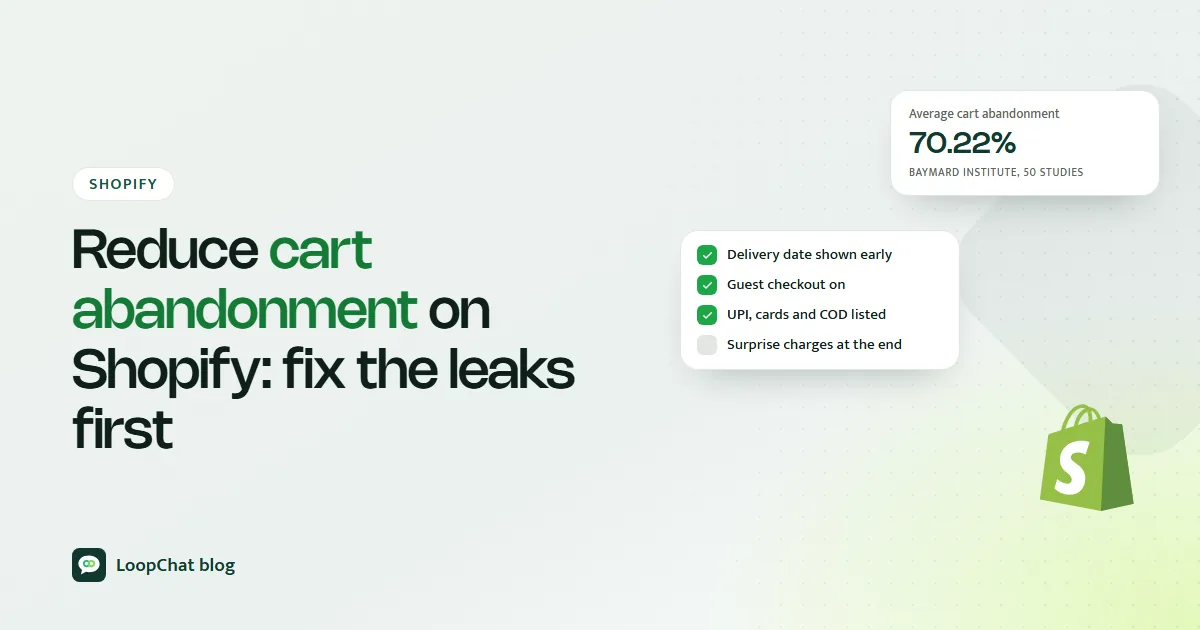
Baymard Institute, which has studied checkout usability for years, puts the documented average online cart abandonment rate at 70.22%, calculated across 50 separate studies. In plain terms, for every ten shoppers who add a kurta or a face serum to their cart, about seven leave without paying.
Not all of that is lost money. Baymard's own survey found that 42% of shoppers who abandoned were simply browsing or not ready to buy. You will never convert all of them. The useful question is how many of the remaining abandoners left because of something you can change, and Baymard estimates that a typical large ecommerce site could lift its conversion rate by 35.26% through better checkout design alone.
Why shoppers leave
When Baymard set the "just browsing" group aside, these were the most common reasons people gave for abandoning during checkout:
| Reason | Share of abandoners giving it |
|---|---|
| Extra costs too high (shipping, tax, fees) | 40% |
| Delivery was too slow | 20% |
| Didn't trust the site with card details | 19% |
| Site wanted them to create an account | 18% |
| Checkout too long or complicated | 17% |
| Site had errors or crashed | 17% |
| Returns policy not good enough | 13% |
| Couldn't see the total cost up front | 12% |
| Card was declined | 10% |
| Not enough payment methods | 9% |
Notice how many of these are decisions you control. Comparison shoppers checking prices across three tabs are a different story, and chasing them hard with discounts rarely pays off.
Mobile makes every problem bigger
Many Indian shoppers arrive on a phone, often from an Instagram ad. On a small screen every extra field is a chore, the keyboard hides the "Continue" button, and a payment page that redirects twice feels broken. Check your device split in Shopify analytics, then test checkout on a mid-range Android phone over mobile data.
It is not only a checkout problem
Shoppers drop at the product page, the cart and the checkout for different reasons, and many stores have no follow-up once someone leaves. Fix each stage, then add recovery at the end. Closing these leaks is also one of the cheapest ways to grow Shopify revenue without raising ad spend.
Find the exact stage where people leave
| Stage | Typical cause |
|---|---|
| Product page | Price doubt, thin details, few reviews, slow images |
| Cart page | Delivery charge revealed, second thoughts, distraction |
| Checkout | Login wall, too many fields, missing UPI or COD, trust worries |
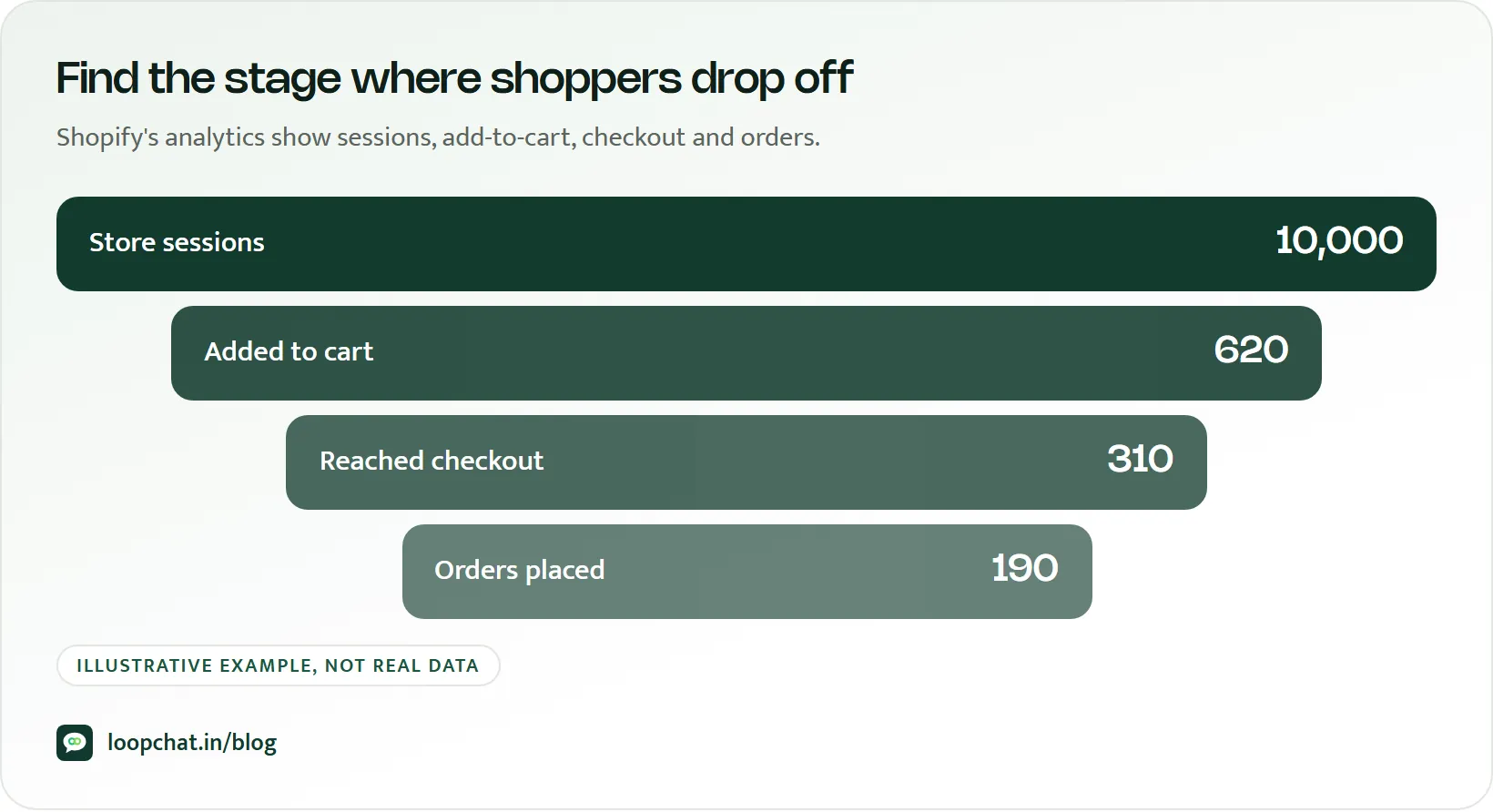
Read your Shopify funnel
Shopify's analytics track sessions with cart additions, sessions that reached checkout and sessions that completed checkout. Compare these numbers week by week. A big gap between "added to cart" and "reached checkout" usually points to the cart page: delivery cost or a confusing cart drawer. A big gap between "reached checkout" and "completed" points to checkout friction or payment trouble. Our post on abandoned cart vs abandoned checkout explains why these two gaps need different fixes.
Watch real sessions
Numbers tell you where, recordings tell you why. Behaviour tools such as Microsoft Clarity and Hotjar show session recordings and heatmaps. Ten recordings of people quitting at the pincode field teach more than a month of guessing.
Split by traffic source
Someone searching "cotton kurta set under 1500" arrives ready to buy; someone who tapped a Reel is often just curious. If one source abandons heavily, check whether the ad promised a price, colour or delivery speed the product page does not match.
Fix 1: say the delivery cost and date early
Extra costs top Baymard's list, so tackle them first. Put the delivery charge or your free-delivery threshold on the product page, not on the last step. A line such as "Free delivery on orders above ₹699, otherwise ₹59" removes the surprise. Show a delivery estimate by pincode if you can: "Delivers to 452001 (Indore) by Thursday" is far more reassuring than "Standard shipping".
Fix 2: make checkout short and account-free
Let people buy as guests. Forced account creation drives away nearly one in five abandoners in Baymard's data, and you can always invite them to create an account after the order. Keep fields to what you need for delivery, let the browser autofill addresses, and keep the whole flow on as few screens as possible. Remove checkout add-ons and apps you do not need.
Fix 3: show trust and the payment methods Indians use
Near the checkout button, show what a cautious first-time buyer looks for: a clear returns or exchange policy link, real reviews, and familiar payment logos. Make UPI a visible option, because many Indian buyers expect to pay with the app already on their phone. If you sell higher-priced items such as phone accessories bundles or premium skincare kits, EMI options can make the decision easier. If you offer cash on delivery, say so early and state any COD fee upfront, then confirm those orders before dispatch as our guide to cutting COD failures explains. We look at how COD, UPI and trust shape Indian checkouts in more depth in why customers abandon carts in India.
Fix 4: no surprises in the final total
A product shown at ₹799 that becomes ₹948 at the last step feels like a trick, even when every rupee is justified. Show the final payable amount, including delivery and any COD fee, as early as you can. Baymard found 12% of abandoners left simply because they could not see the total cost upfront.
Offers that help instead of training discount-hunters
Exit-intent pop-ups (triggered when the cursor heads for the tab bar on desktop, or after inactivity on mobile) can catch some leavers. Match the offer to the likely objection: if delivery cost is the issue, offer free delivery, not a random percentage off.
Keep urgency honest. A real "free delivery if you order today" is fine; a countdown timer that resets on every reload damages trust. And skip the discount in every reminder, or regular customers learn to abandon on purpose.
Follow up on WhatsApp, briefly
Some shoppers will leave even after all these fixes. For them, a short, friendly reminder works well, and for Indian buyers WhatsApp is often where they actually read messages. A sensible starting point to test: the first reminder within an hour or two, a second around a day later if there is no reply, and then stop. One timely message beats three badly timed ones. A reminder might read:
Two rules: the shopper must have agreed to hear from you on WhatsApp, and Meta treats cart reminders as marketing templates, which are charged per delivered message. Our cart recovery playbook covers sequences, consent and costs in detail.
Answer the question that stopped the sale
Plenty of carts are abandoned over a single unanswered question: "Do you deliver to Kochi?", "Can I pay by UPI on delivery?", "What if the size doesn't fit?". If a shopper can ask that on WhatsApp and get an answer in seconds, the sale often survives. An AI agent trained on your delivery, payment and returns details can answer these at any hour and hand over to a person when needed. For realistic expectations, see our piece on what AI customer support can and cannot do.
Manual follow-up stops scaling fast
A handful of abandoned carts a day can be messaged by hand. As volume grows, manual follow-up gets patchy: weekends are skipped and nobody knows which messages led to orders. Then move to WhatsApp automation that triggers from Shopify, and whatever tool you use, make sure it stops messaging once the customer buys. Our roundup of Shopify cart recovery apps compares the tools that do this.
Habits that keep working
Prioritise high-intent shoppers. Someone who reached the payment step is far closer to buying than someone who left from the cart, so give them the quickest, most helpful follow-up. Treat repeat customers, who usually need only a nudge, differently from first-time visitors, who may need reassurance about returns or delivery.
Cap your messages. Five messages across email, SMS and WhatsApp in two days will get you blocked. Decide on a maximum, and only send a final message when you have a real reason: a price drop, low stock, or an offer that genuinely ends.
Measure what matters. Track recovered orders and recovered revenue by channel, not opens or clicks. If one channel brings back more completed orders, move effort there.
Frequently asked questions
What is a normal cart abandonment rate for a Shopify store?
Baymard's documented average across 50 studies is 70.22%, so a rate around 70% is normal rather than alarming. Your own rate will vary with category, price point and how much of your traffic is mobile or social. Track the trend in your Shopify funnel after each fix rather than chasing a universal benchmark.
Can WhatsApp recover abandoned carts?
Yes. For shoppers who have opted in, a short WhatsApp message with their product and a direct checkout link is an effective reminder, and it lets them reply with a question instead of leaving silently. Recovery results vary by store, so measure recovered orders rather than relying on industry claims.
What is the fastest way to reduce cart abandonment?
Fix the store first: show delivery costs early, allow guest checkout, offer UPI and COD clearly, and cut unnecessary fields. Then add a short WhatsApp reminder sequence for the shoppers who still leave.
How LoopChat helps
LoopChat connects to your Shopify or WooCommerce store and sends abandoned cart and checkout reminders on WhatsApp automatically, using approved templates. The same setup handles COD order confirmation and order and shipping updates, so the post-purchase side is covered too. You can see the options on our ecommerce page.
When a shopper replies with a question, LoopChat's AI agent answers from your business information in English, Hindi or Hinglish, and your team can take over in the shared inbox with one click. Shopify connections are included from the Sprint plan, and Meta's message charges are separate; see pricing. To try it on your own store, start a 15-day free trial or book a demo.
Sources
- Baymard Institute: 50 Cart Abandonment Rate Statistics 2026 (accessed October 2026)
- Shopify.dev: ShopifyQL sessions schema (cart additions, reached checkout, completed checkout) (accessed October 2026)
- Meta for Developers: Template categorization guidelines (accessed October 2026)
- Meta for Developers: WhatsApp Business Platform pricing (accessed October 2026)
- Meta for Developers: Get opt-in for WhatsApp (accessed October 2026)