Shopify cart recovery apps compared (2026): ten options for Indian stores
Ten options, from Shopify's free built-in emails to WhatsApp, SMS, push and chat tools, judged on the same five criteria.
Contents
The best Shopify cart recovery app is the one that reaches your shoppers on the channel they actually read and reports recovered orders, not just clicks. For many stores that starts with Shopify's free abandoned checkout emails; email-heavy brands often add Klaviyo or Omnisend, US-focused stores lean on SMS tools such as Recart, and Indian D2C brands usually need WhatsApp and COD confirmation in the mix. Below are ten options described only from their official listings and websites, with prices as shown in October 2026.
What a cart recovery app does
A cart recovery app notices when a shopper leaves without paying and follows up with a reminder that takes them straight back to what they were buying. Better tools add multi-step sequences, conditions (cart value, first-time or returning buyer), several channels and reporting on the revenue that came back. No app can make up for a store that leaks, so it pays to reduce cart abandonment on Shopify first.
How recovery works
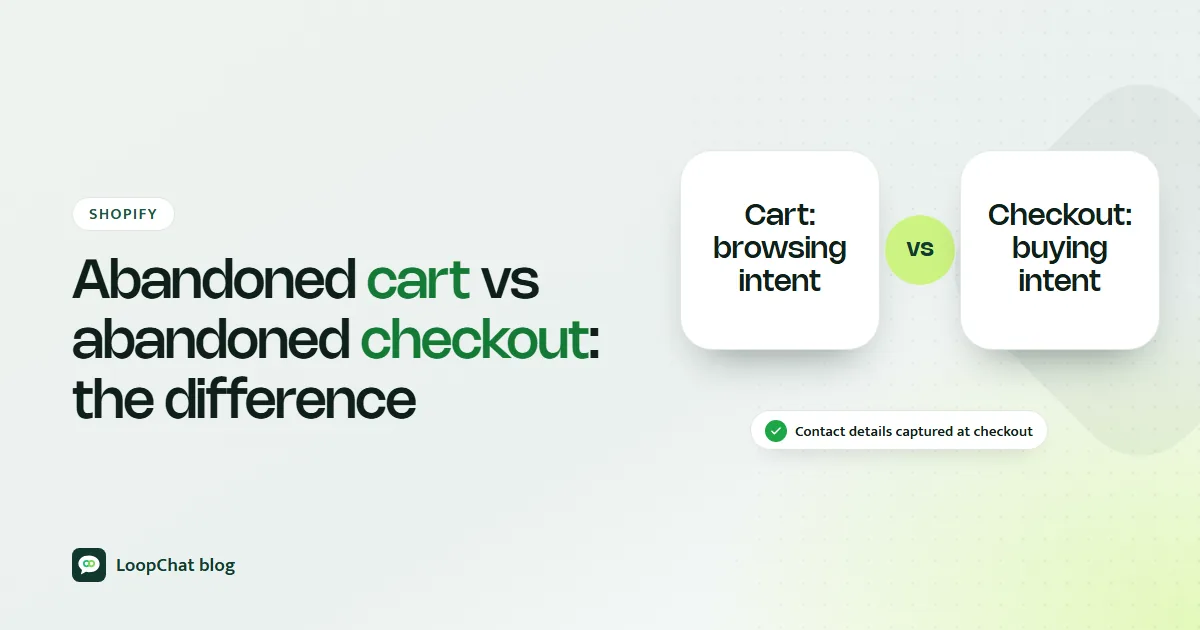
### Carts versus checkouts An abandoned cart means items were added but checkout never started; the shopper is often anonymous. An abandoned checkout means the shopper started checkout and gave contact details. Shopify itself defines an abandoned checkout as one left incomplete for more than ten minutes after the customer entered their email. We cover the difference in detail in abandoned cart vs abandoned checkout.
### Channels Email is universal and cheap. SMS is strong in markets where texting is the habit. WhatsApp is where many Indian shoppers reply, and it needs the customer's opt-in and approved templates. Web push reaches visitors who never shared contact details, if they allowed notifications. Some vendors also offer phone or voice follow-ups. On-site chat works earlier, before the shopper leaves.
### Links that rebuild the cart A good reminder carries a link that reopens the shopper's own checkout with the same items, often showing product names, images and the total in the message itself so the shopper remembers what they left.
### Reporting that counts orders Delivery and open rates tell you the message arrived. The figure that matters is orders and rupees recovered per flow, ideally separated by channel, so you can switch off what does not pay for itself.
Our criteria
We looked at each app on five points and did not rank them by number; the order below is not a league table.
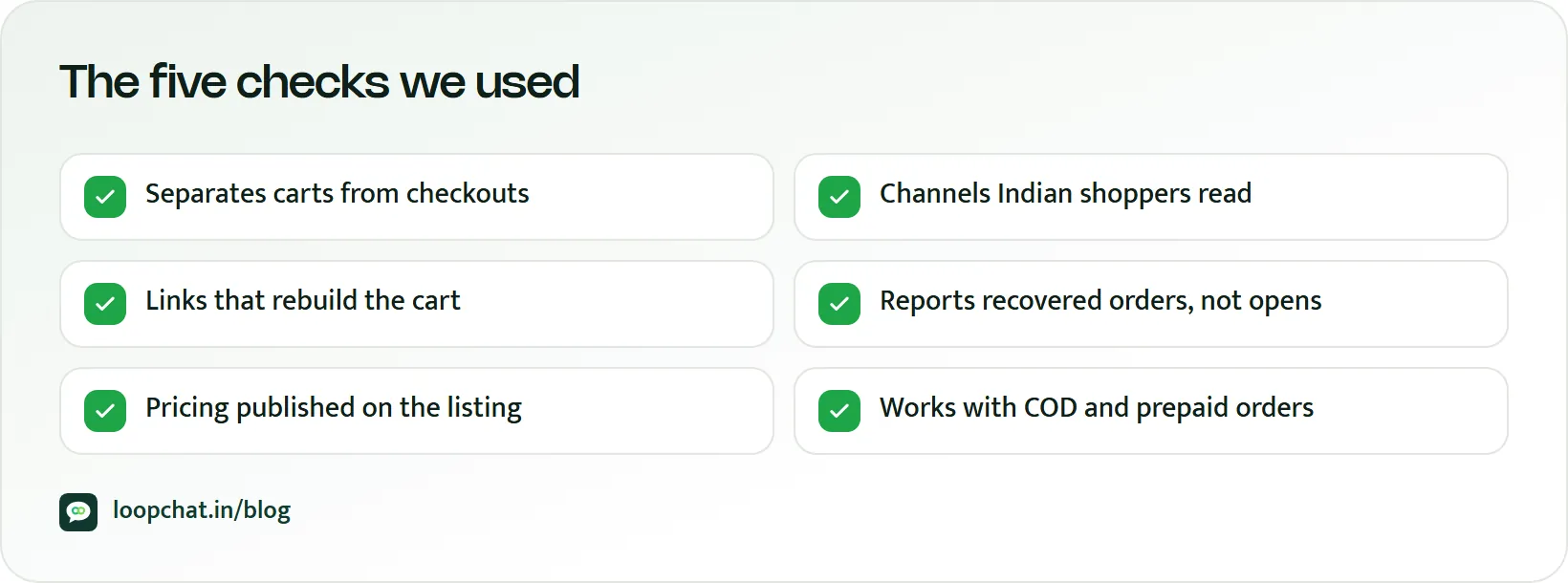
- Channels: does it reach shoppers where they respond?
- Automation depth: multiple steps, conditions by cart value or customer type?
- Shopify fit: native Shopify app with live checkout data?
- Pricing model: per contact, per message, flat fee or managed service, and are message charges extra?
- Reporting: does it show recovered revenue per flow?
The apps
### Shopify abandoned checkout emails (built in) Shopify can send an abandoned checkout email automatically from Apps > Messaging > Automations, with a link back to the shopper's checkout, a "Send after" delay and editable branding. Shopify says these automation emails are free and do not count toward the 10,000 free emails each store gets per month. Limits: it needs an email address (if the shopper entered only a phone number, no email can be sent), it covers only the Online Store and Buy Button channels, and Shopify's help pages describe a single email per automation, with timing adjustable through Shopify Flow. The obvious first step for every store.
### Klaviyo An email, SMS and push platform whose Shopify listing includes abandoned cart, checkout and browse abandonment campaigns, segmentation and AI-assisted segments and flow triggers. Its pricing page lists a free plan for up to 250 active profiles with 500 email sends a month; paid plans scale with your profile count. Best for brands with someone who will build and maintain detailed flows. We set it against a WhatsApp-first setup in LoopChat vs Klaviyo.
### Omnisend Email, SMS and web push in one app. The Shopify listing shows a free plan for up to 250 contacts and 500 emails a month with abandoned cart automation included, Standard from $16 a month and Pro from $59 a month, rising with list size, with SMS from $0.007 per message on Pro. A simpler multichannel setup than most.
### Recart An SMS marketing app with popups that collect phone numbers and emails, plus automations for welcome, abandoned cart and reorder messages. The listing shows a Free plan and a Starter plan at $299 a month, each with a dedicated customer success manager, and describes a fully managed service. Suited to SMS-first stores that want help running the programme.
### Brevo PushOwl Web push, email and SMS on Brevo. The free plan includes 500 push notifications and 500 emails a month; abandoned cart recovery starts on the Plus plan at $19 a month, and browse abandonment on Power at $79 a month. Useful as an extra channel for anonymous visitors.
### Cartly Abandoned Cart Recovery Email and web push recovery with popups and spin-to-win discounts, from the developer Care Cart. The free Basic plan includes 100 recovery emails and unlimited push; Pro is $14.99 a month for unlimited emails. A budget-friendly email and push option.
### Dondy: WhatsApp Marketing+Chat WhatsApp marketing, AI chat agents and a multi-agent inbox. Read the plans carefully: Pro at $6.99 a month offers manual cart recovery, while automated WhatsApp cart recovery starts on Power Automation at $79.99 a month.
### CK: Abandoned cart on WhatsApp From Carthike, an India-based developer. WhatsApp cart reminders, order confirmation, shipping and COD verification messages, and a chat button. Automated recovery and COD confirmations start on VIP at $9.99 a month; Advanced at $29 adds multiple automated reminders and a team inbox. Automated messages are charged separately, from $0.02 each depending on country.
### Tidio Live chat and the Lyro AI agent, with an inbox covering chat, email, Instagram and WhatsApp, rather than a reminder tool: it starts conversations on product pages, answers questions, can add items to the cart and handles order status, refunds and edits within rules you set. Paid plans start at $29 a month. Best when unanswered questions are why people leave.
### LoopChat A WhatsApp, Instagram and website chat platform for Indian businesses on the official WhatsApp Business Platform. With Shopify or WooCommerce connected, it sends abandoned cart and checkout reminders, COD order confirmations, order and shipping updates and reorder nudges, and replies go to a shared inbox with an AI agent that answers in English, Hindi and Hinglish. Its channels are WhatsApp, Instagram and website chat. Shopify connections are on selected plans (see pricing); Meta's message charges are separate.
Side by side
| Channel | Apps in this list (per their listings) |
|---|---|
| Shopify built-in, Klaviyo, Omnisend, Brevo PushOwl, Cartly | |
| SMS | Klaviyo, Omnisend, Recart, Brevo PushOwl |
| Dondy, CK, LoopChat; Klaviyo names it in its listing headline; Tidio inbox | |
| Push notifications | Klaviyo, Omnisend, Brevo PushOwl, Cartly |
| On-site chat | Tidio, LoopChat |
For Indian D2C brands, the WhatsApp tools matter most because COD confirmation and quick replies happen there; pair one with Shopify's free emails. For advanced automation, Klaviyo and Omnisend both list branching email and SMS flows with segmentation. On attribution, Recart lists click-only attribution and real-time analytics, and LoopChat reports revenue attribution on its Turbo plan; check how each tool defines a recovered order before comparing numbers.
Six flows worth setting up
- Browse abandonment: a gentle nudge for opted-in shoppers who viewed a product repeatedly.
- Cart abandonment: reach known visitors, or anonymous ones via push.
- Checkout abandonment: your highest-intent flow; answer the likely blocker.
- High-value cart: a personal reply from your team instead of a discount.
- COD confirmation: confirm before dispatch to avoid refused parcels. See how to reduce COD failures.
- Second chance: one final, polite message a few days later, perhaps with an incentive.
Getting more back from the same flows
- Send the first reminder within an hour. A common starting pattern is three messages: about an hour, a day, and two to three days after. > Before paying for any app, switch on Shopify's free abandoned checkout email so you have a baseline to compare against.
- Write differently for carts and checkouts. A checkout abandoner may have hit a delivery charge or a failed UPI payment; our look at why Indian shoppers abandon carts lists the usual blockers.
- Save incentives for later messages, and skip them on large carts.
- Combine channels without repeating yourself. If WhatsApp gets a reply, stop the email.
- Judge flows on recovered revenue. Our full guide to Shopify abandoned cart recovery explains how to measure it.
Which one fits your store
- New or low-volume store: Shopify's built-in emails, perhaps with Cartly or the PushOwl free plan.
- Email-first brand: Klaviyo or Omnisend.
- WhatsApp-first Indian D2C brand: CK, Dondy or LoopChat, depending on whether you want only reminders or a full team inbox and AI replies. See WhatsApp automation.
- High COD volume: a WhatsApp tool with COD confirmation, such as CK or LoopChat.
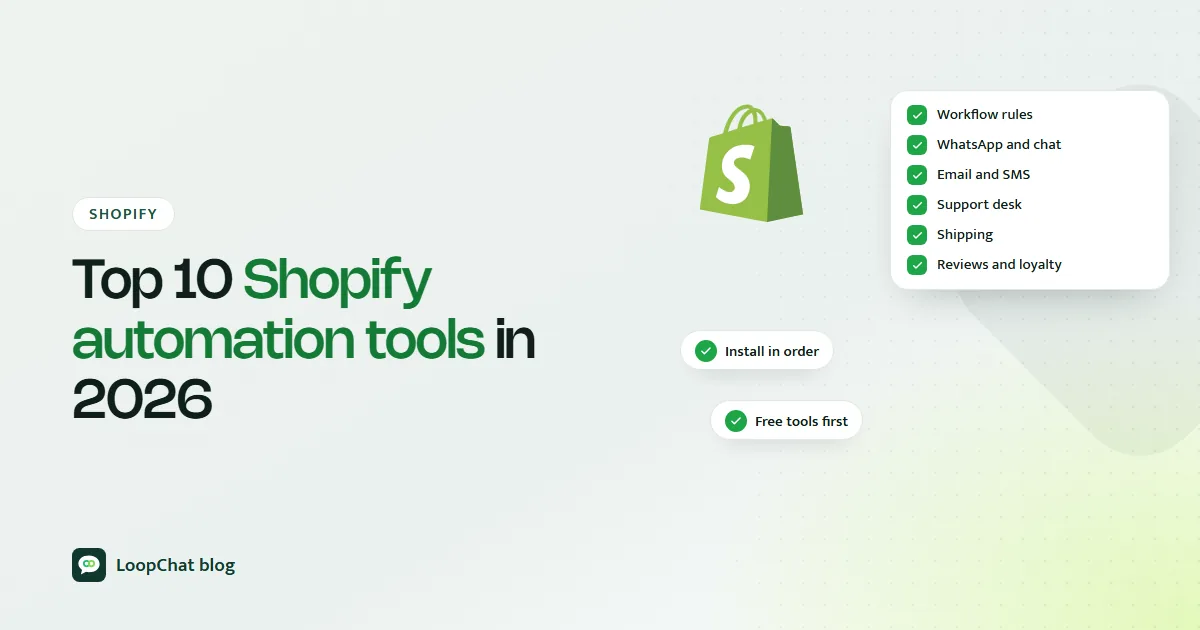
- Complex, multi-team automation: Klaviyo, or a platform with an API and webhooks. Our Shopify automation tools roundup covers the wider field.
Frequently asked questions
### Is there one right cart recovery app for every store? There is no single best. Start with Shopify's free abandoned checkout emails, then add the channel your customers respond to: email and SMS tools for email-led brands, WhatsApp tools for most Indian D2C stores.
### Does Shopify have built-in abandoned cart recovery? Shopify has built-in abandoned checkout emails. They go to shoppers who entered an email at checkout and left it unfinished for more than ten minutes, and Shopify says these automation emails are free.
### Cart reminders or checkout reminders: which matters more? Cart recovery targets people who added items but never started checkout, often anonymous. Checkout recovery targets people who began checkout and shared contact details, so they can be reached directly.
### Should Indian stores send reminders on WhatsApp? It suits markets like India where customers already use WhatsApp daily, and it allows two-way conversation. You need the customer's opt-in and Meta-approved templates, and Meta charges per message; estimate costs with the WhatsApp pricing calculator.
### How many reminders is too many? Two or three is a sensible default: one within the hour, one the next day, and an optional final one a couple of days later. Stop as soon as the shopper buys or replies.
### What about shoppers who plan to pay cash on delivery? Recovery reminders work the same way whatever the payment method. For COD stores, the bigger win is a confirmation step after the order, which some WhatsApp tools in this list include.
How LoopChat helps
LoopChat runs WhatsApp abandoned cart and checkout reminders, COD confirmations and order updates from your Shopify or WooCommerce store, and lets you customise them in a no-code flow builder. Replies go to a shared inbox where the AI agent answers questions and hands over to your team in one click. Plans and limits are on the pricing page.
Sources
- Shopify Help Center: Recovering abandoned checkouts (accessed October 2026)
- Shopify Help Center: Opt in to the new abandoned checkout automation (accessed October 2026)
- Shopify Help Center: Shopify Messaging email pricing (accessed October 2026)
- Klaviyo: Klaviyo Pricing (accessed October 2026)
- Shopify App Store: Klaviyo: Email Marketing & SMS (accessed October 2026)
- Shopify App Store: Omnisend Email Marketing & SMS (accessed October 2026)
- Shopify App Store: Recart: SMS & List Growth (accessed October 2026)
- Shopify App Store: Brevo PushOwl: Email, Push, SMS (accessed October 2026)
- Shopify App Store: Cartly Abandoned Cart Recovery (accessed October 2026)
- Shopify App Store: Dondy: WhatsApp Marketing+Chat (accessed October 2026)
- Shopify App Store: CK: Abandoned cart on WhatsApp (accessed October 2026)
- Shopify App Store: Tidio: AI Chatbot & Live Chat (accessed October 2026)
- Meta for Developers: Get opt-in for WhatsApp (accessed October 2026)