Why customers abandon carts in India: COD, surprise costs and trust
Indian shoppers leave carts for familiar reasons, plus a few local ones: COD doubts, late delivery charges and wariness of new brands.
Contents
- Cart abandonment in India: same habit, different reasons
- Seven reasons Indian shoppers leave
- How COD shapes abandonment
- Delivery and returns: the questions shoppers ask before paying
- Trust gaps on a new D2C site
- Six fixes for Indian D2C checkouts
- Diagnose your own store before you fix it
- Frequently asked questions
- How LoopChat helps
Indian shoppers abandon carts for the same core reasons as shoppers everywhere: extra costs that appear late, slow or confusing checkouts, and doubts about the store. What makes India different is how heavily cash on delivery, UPI availability and trust in unfamiliar brands weigh on that decision. If you run a D2C store, fixing those three things usually matters more than any discount code.
Cart abandonment in India: same habit, different reasons
Adding to cart and walking away is universal. In India, though, a large share of online shoppers are relatively new to buying online, many are price-sensitive, and many shop on budget Android phones with patchy mobile data. A first-time buyer in Indore looking at a ₹799 snack hamper from a brand they found on Instagram is weighing questions a regular Amazon shopper in Bengaluru never thinks about: is this site real, can I pay cash, and what will the final amount actually be?
How common is it?
Baymard Institute, which compiles cart abandonment studies, puts the documented average online cart abandonment rate at 70.22% across 50 studies. That figure is global rather than India-specific, but it gives a useful sense of scale: most carts never become orders.
You will see India-specific abandonment rates and checkout completion benchmarks quoted widely, but we could not trace them to a published primary study, so we have not repeated them here. Treat any single India figure as a rough indication, and benchmark against your own store's numbers month by month instead.
Seven reasons Indian shoppers leave
Baymard's survey of reasons for abandoning during checkout is led by extra costs being too high (shipping, tax, fees), followed by slow delivery, lack of trust, forced account creation and long or complicated checkouts. In India those show up in local forms:
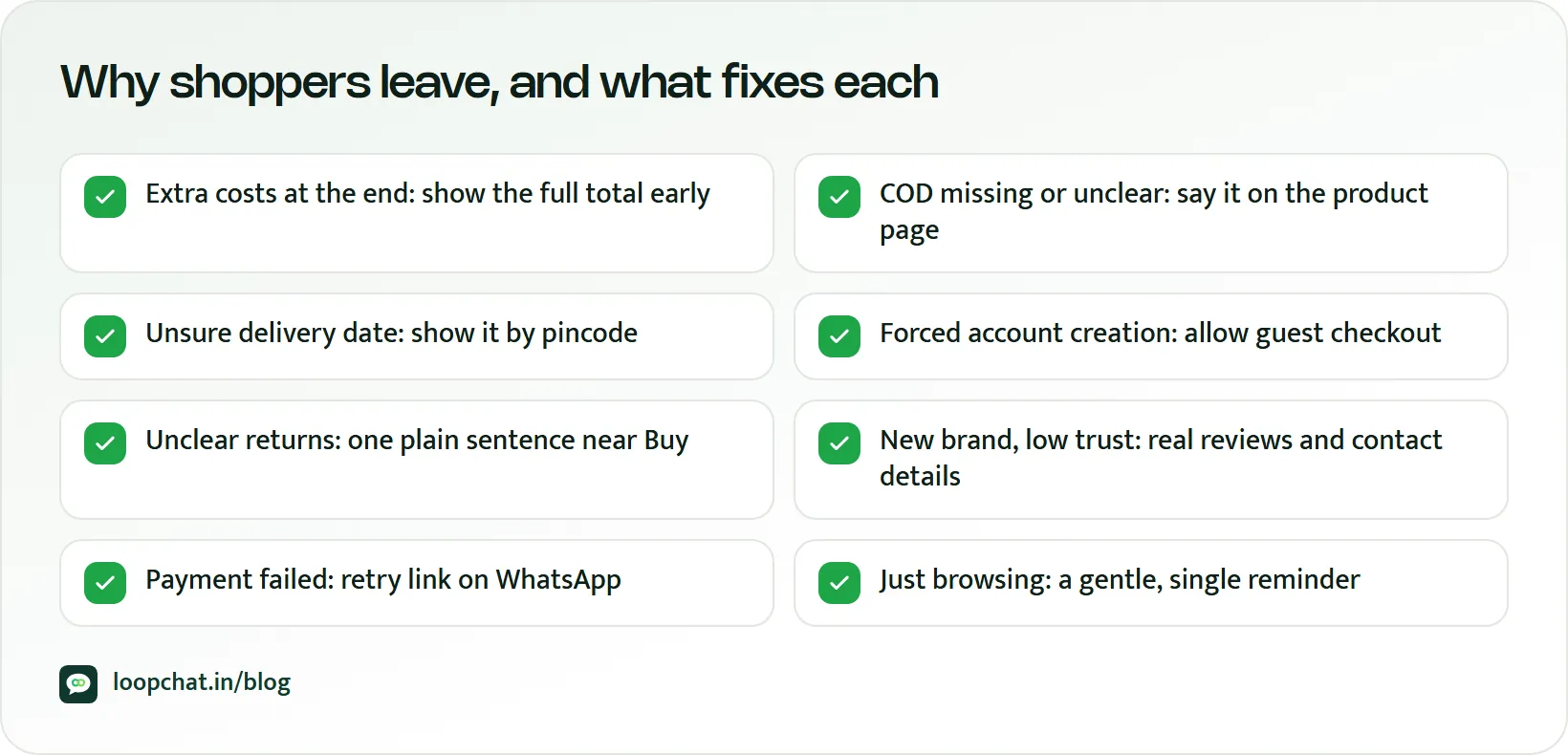
- Surprise shipping and COD charges. A ₹49 delivery fee and a ₹30 COD fee that appear only on the last screen feel like a bait and switch to a price-conscious shopper.
- Wanting COD, but not quite committing. Many shoppers want COD to be available, yet still hesitate to place even a COD order with a brand they do not know.
- Slow, long checkouts. Forced sign-ups, long forms and several steps hurt more on low-end phones and slower networks in tier-2 and tier-3 cities.
- Missing or buried payment options. The RBI's Annual Report 2024-25 notes that UPI had the highest share of retail payments by volume, at 84 per cent. A checkout that hides UPI, or offers cards first, loses people who expected to pay in two taps. For what accepting UPI now costs a merchant, see our explainer on UPI merchant charges from October 2026.
- Trust and security worries. "Is this brand genuine? Will my money be safe?" These doubts are rarely said out loud. They just show up as abandoned carts.
- Uncertain delivery and returns. No delivery date, or a returns policy that is hard to find, makes shoppers unsure what happens after they pay.
- Window carting. Some shoppers add items to see the final price, compare with a marketplace, or save items for payday. Not every abandoned cart was a lost sale.
How COD shapes abandonment
COD is a trust signal, not just a payment preference
For a first order from a new D2C brand, COD acts as insurance: if the parcel never arrives or looks nothing like the photos, the shopper has lost nothing. If you read COD demand only as "Indians prefer cash", you miss the shoppers who would happily pay by UPI once they trust you.
First order on COD, repeat orders prepaid
A common pattern is that a customer's first order is COD and, after a smooth delivery, later orders are prepaid. That trust curve is why a "pay by UPI next time and save ₹50" message after a successful first delivery tends to make sense. Fewer COD orders also means fewer refused parcels, which our RTO playbook for Shopify stores tackles directly.
The COD experience matters as much as COD availability
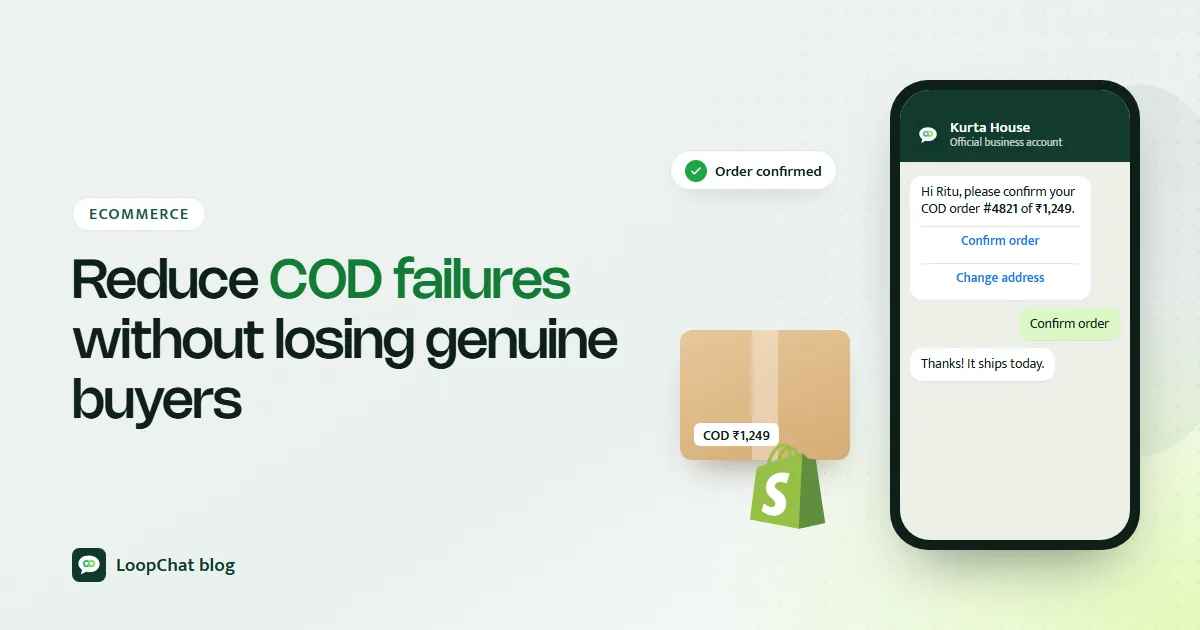
Offering COD is not enough if the experience around it feels like friction. A quick WhatsApp message confirming the order, the amount and the delivery date builds confidence. An unexplained fee, or an order that sits unconfirmed for a day, does the opposite. We cover how to design that step in how to reduce COD failures.
Delivery and returns: the questions shoppers ask before paying
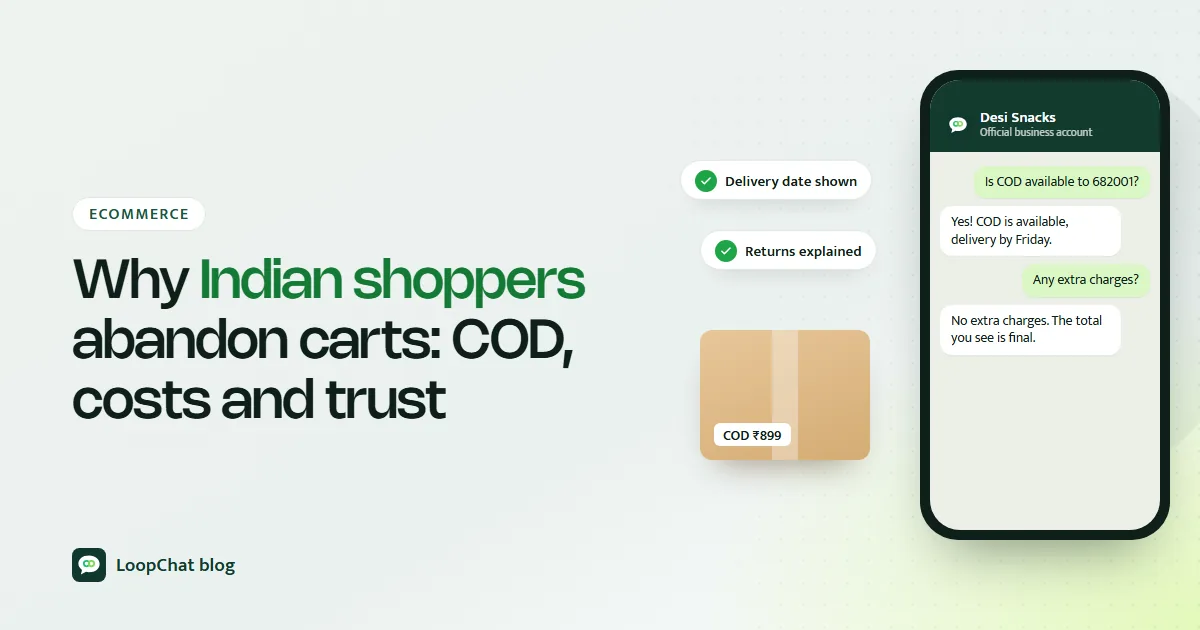
- Hidden charges at the end. Show shipping, COD fees and taxes on the product or cart page, not just on the final screen. A free-shipping threshold ("Free delivery above ₹599") works best when it is visible early.
- Vague delivery timelines. "Delivered in 4 to 6 days to 682001" is more reassuring than "ships soon", even though it promises a longer wait. A pincode checker on the product page answers the question before it becomes a reason to leave.
- Unclear returns. For apparel, footwear and skincare, where fit or skin reaction is uncertain, shoppers want to know if they can exchange before they commit. Link a short returns summary right next to the buy button.
Trust gaps on a new D2C site
- No marketplace safety net. On a marketplace, the platform's reputation reassures the buyer. On your own Shopify store, every trust signal has to come from you.
- Payment security doubts. Shoppers newer to online payments may default to COD, or leave if COD is missing.
- Thin social proof. Real reviews with photos, a visible support number, clear company details and a verified WhatsApp business profile all help. Our guide to WhatsApp blue tick verification in India explains how that badge works.
Six fixes for Indian D2C checkouts
- Show the full cost upfront. Shipping, COD fees and taxes on the product or cart page.
- Shorten checkout. Allow guest checkout, cut optional fields and test on a budget Android phone over mobile data. Our guide on how to reduce cart abandonment on Shopify walks through each on-site fix.
- Put UPI first and explain COD. Show UPI, wallets and COD clearly, and state any COD fee or confirmation step before the final screen.
- Add trust at the payment step. Reviews, secure payment badges, a delivery promise and an easy returns link.
- Be honest about delivery and returns. Pincode-based delivery estimates and a returns summary in plain language.
- Recover what still slips away. Shopify counts a checkout as abandoned when a customer has entered their email and not completed it within ten minutes, and it can send recovery emails automatically. Many Indian stores add WhatsApp reminders on top. Our guide to Shopify abandoned cart recovery covers timing and message sequences.
Diagnose your own store before you fix it
Payment mix, cost transparency and trust are three separate problems, and each needs a different fix. A missing COD option needs a payment change. A surprise delivery fee needs a pricing and display change. A trust gap needs reviews, support and proof. Look at where your shoppers actually drop off (cart page, shipping step, payment step) and which devices and cities they come from, then fix the biggest leak first instead of copying an industry average. Our explainer on abandoned cart vs abandoned checkout shows how to read those stages in Shopify.
Frequently asked questions
What is the average cart abandonment rate in India?
There is no single authoritative India figure. Baymard Institute's global average across 50 studies is 70.22%, and India-specific numbers quoted online vary. The most useful benchmark is your own abandonment rate tracked over time.
Why is COD so popular in India?
It works as a trust mechanism. For a first order from an unfamiliar brand, paying on delivery means the shopper risks nothing if the product never arrives or disappoints. Once a brand has delivered well, many customers are willing to pay upfront.
How can D2C brands reduce COD-related abandonment?
Offer COD without surprise fees, state any COD charge or confirmation step early, confirm orders quickly in a friendly way, and use a successful first delivery as the moment to invite customers to pay by UPI next time.
Does offering more payment options reduce abandonment?
Only when they are the options your shoppers expect. In India that usually means UPI shown prominently, plus cards, wallets and COD. Adding methods nobody uses just clutters the payment step.
Can WhatsApp or SMS recovery bring back abandoned carts in India?
Yes, it can recover some of them, especially shoppers who left because of a doubt that a quick reply can answer. Keep reminders few and relevant, include the cart link and a way to ask a question, and only message customers who have agreed to hear from you.
How LoopChat helps
LoopChat connects to Shopify and WooCommerce and sends abandoned cart and checkout reminders on WhatsApp, along with COD order confirmations and order and shipping updates. Customers who reply with a question reach a shared inbox or an AI agent that answers from your business information in English, Hindi or Hinglish, with one-click handover to your team. You can also send payment links to shoppers who are ready to pay by UPI. See how this fits an online store on our ecommerce page.
Store connections and flows are on the Sprint and Turbo plans. Start a 15-day free trial or book a demo.
Sources
- Baymard Institute: Cart abandonment rate statistics (accessed October 2026)
- Reserve Bank of India: Annual Report 2024-25, Chapter IX, Payment and Settlement Systems and Information Technology (accessed October 2026)
- Shopify Help Center: Recovering abandoned checkouts (accessed October 2026)