UPI MDR for merchants: the 0.4% charge above ₹2,000, and why it did not start on 15 October 2026
The government announced a 0.4% MDR on larger UPI merchant payments, then NPCI deferred it to after Diwali. What D2C brands should know and do now.
Contents
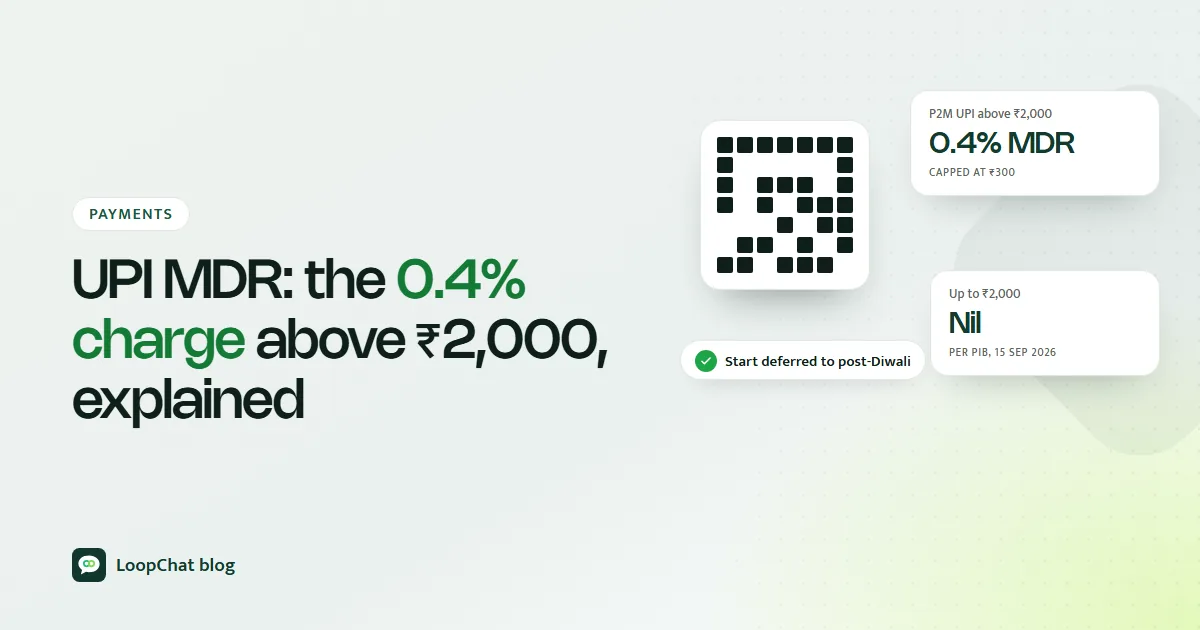
The government has announced a merchant discount rate (MDR) of 0.4% on person-to-merchant (P2M) UPI payments above ₹2,000, capped at ₹300 for payments of ₹75,000 and above. It was scheduled to start on 15 October 2026, but on 13 October NPCI said it will be implemented "immediately post Diwali", on a date still to be notified. We could find no notified date in NPCI or PIB releases as of 20 October 2026, so UPI merchant payments remain at zero MDR for now.
Payments up to ₹2,000, all person-to-person transfers and small merchants under NPCI's P2PM category stay free. Here is what the framework says, what it would cost a typical D2C store, and what to do while the date is pending.
What was announced
On 15 September 2026 the Ministry of Finance, through a PIB release, and the Department of Financial Services, through a set of FAQs, set out the new UPI MDR framework. PIB says it is introduced under the Payment and Settlement Systems Act, 2007, after deliberations by the UPI Steering Committee. It will replace the zero-MDR regime that has applied to P2M UPI payments since January 2020.
The core rule: a 0.4% MDR on P2M UPI transactions above ₹2,000, capped at ₹300 per transaction for payments of ₹75,000 and above.
PIB says roughly 96% of merchant transactions will be unaffected, because they are either ₹2,000 or below or covered by the small-merchant exemption. Only about 4% of merchant transactions would attract MDR.
PIB is also clear that MDR is not a tax or a government fee. It is shared among banks, payment service providers and UPI app providers, and an amount equal to 5% of total MDR collections goes into a fund to promote UPI among small merchants.
What stays free
- Person-to-person transfers of any amount, including self-transfers.
- P2M payments up to ₹2,000.
- Small merchants under the P2PM category: vendors receiving up to ₹1 lakh a month through UPI QR directly into their own accounts keep zero MDR on all transactions. A P2PM merchant whose inward UPI credits exceed ₹1 lakh a month for three consecutive months is moved to the regular P2M category.
- UPI AutoPay and mandates: the FAQs say recurring mandates for utility bills, OTT subscriptions and recurring investments carry no prescribed MDR.
Consumers do not pay anything, and UPI apps are barred from charging platform fees on UPI payments.
Special rates
- Essential and thin-margin sectors: railways, telecom, insurance, fuel and agricultural inputs pay a flat ₹5 per transaction above ₹2,000. The FAQs also put utility bill payments and education fees in a concessional category.
- Capital markets: payments to mutual funds, stockbrokers and securities dealers pay 0.02%, capped at ₹300.
The FAQs add that credit-linked UPI, such as RuPay credit cards on UPI and pre-sanctioned credit lines, follows separate credit product rules. The new MDR is about payments straight from a customer's bank account to a merchant account.
The date: announced for 15 October, now after Diwali
The FAQs dated 15 September said the framework would take effect from 15 October 2026, giving banks and payment aggregators a month to update their systems. On 13 October, NPCI announced that the UPI and Services Steering Committee had decided, in view of the festive season, to implement MDR on select P2M transactions immediately after Diwali, at a date to be notified separately.
So the festive sale season runs at zero MDR. The rates and thresholds above have not been withdrawn, only the start date has moved. Watch NPCI and PIB for the notification rather than social media forwards, which the FAQs themselves warn about.
Does it apply to your store?
If you run a Shopify or WooCommerce store and collect UPI through a payment gateway checkout, you are almost certainly a regular P2M merchant. The P2PM exemption is defined for small vendors receiving QR payments into their own bank accounts, so a brand collecting through a gateway should not expect it. That is our reading of the definition, so confirm your category with your gateway.
Whether you pay MDR then comes down to order value. A snacks brand in Kochi whose orders mostly sit at ₹600 to ₹1,500 will see little change. A skincare or ethnic-wear brand where many orders cross ₹2,000 will.
The FAQs describe MDR as paid by the merchant to its acquiring bank. If you collect through a payment aggregator, ask how it will show up: a change to your UPI pricing, a separate line on settlement reports, or both. Payment gateways also set their own fees, which this framework does not fix.
You cannot add it to the customer's bill
The FAQs say onboarded merchants cannot pass MDR on to customers when accepting UPI, and PIB says banks have been advised to make sure merchants do not. A "UPI convenience fee" at checkout is off the table.
What it costs per order
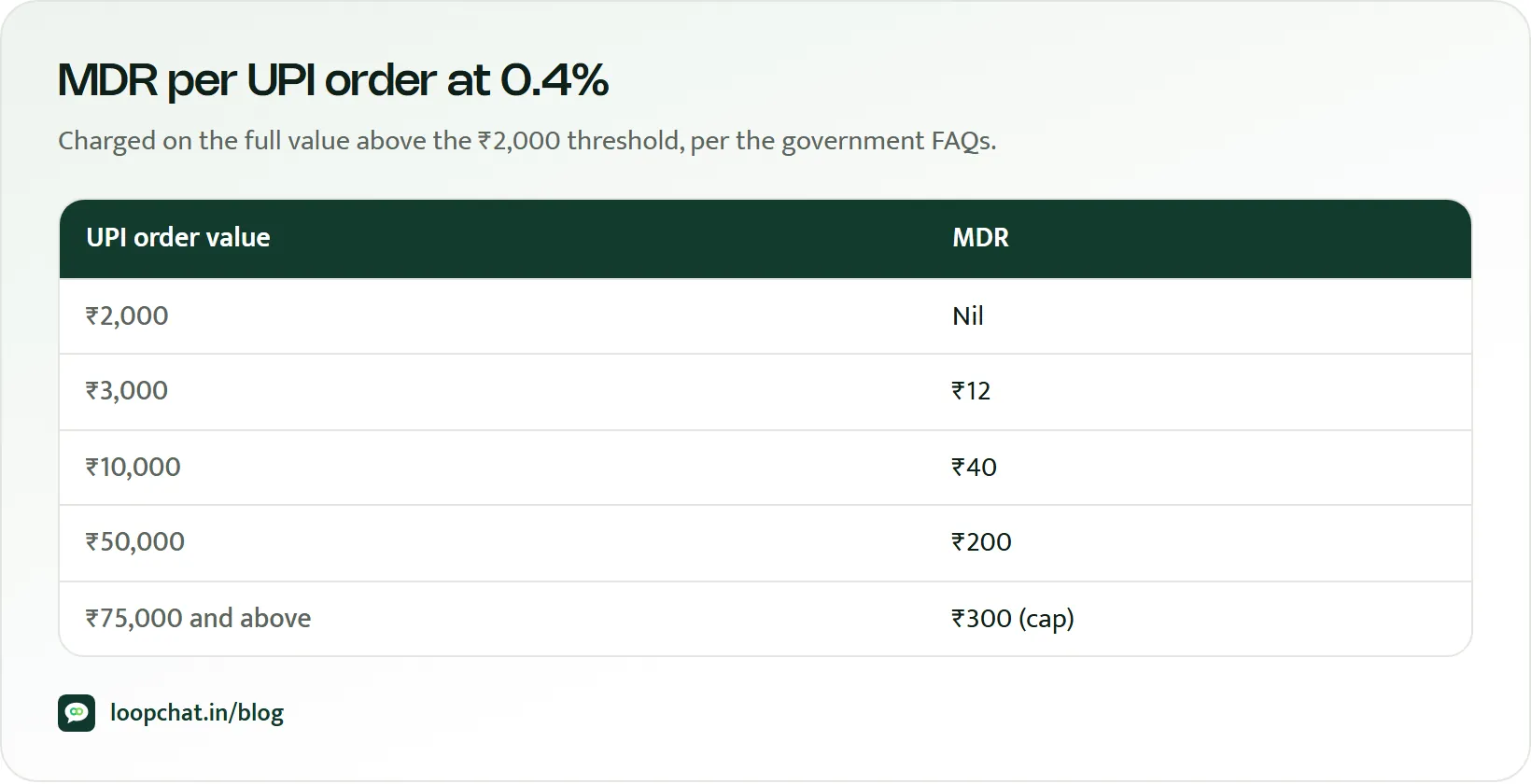
| UPI order value | MDR at 0.4% |
|---|---|
| ₹2,000 | Nil |
| ₹3,000 | ₹12 |
| ₹10,000 | ₹40 |
| ₹50,000 | ₹200 |
| ₹75,000 and above | ₹300 (cap) |
The ₹3,000, ₹50,000 and capped examples come straight from the government's FAQs.
Working out your monthly figure
Export last month's prepaid UPI orders from your gateway, keep only those above ₹2,000, take 0.4% of each (capping any single order at ₹300), and add them up.
As a hypothetical, a Jaipur kurta brand with 400 prepaid UPI orders above ₹2,000 at an average of ₹2,800 would pay about ₹4,480 a month (400 × ₹11.20). Run the same sum on your own data. The PIB release of April 2025 noted that GST is levied on charges such as MDR, so check your gateway invoices for how tax is shown.
Three mistakes to avoid
Passing it on. As above, the rules do not allow it, and it would irritate customers at the moment of payment.
Pushing customers back to COD. A few rupees of MDR on a ₹2,800 order is small next to the cost of a COD parcel that comes back. Our guides to reducing COD failures and reducing RTO cover that side of the trade-off.
Removing UPI. It remains a cheap digital acceptance method, and the government's FAQs point out that typical credit card MDRs run at 1.5% to 2.5%.
How to protect your margin
Compare the prepaid incentive with the COD loss. If a small prepaid discount costs less than your average loss per returned COD order, it pays for itself even with MDR.
Confirm COD orders and nudge customers to prepay. A WhatsApp message asking a customer in Indore to confirm their COD order, with a payment link to switch to prepaid, cuts fake orders and shifts some volume to UPI.
Grow repeat value. Reorder reminders and win-back messages raise lifetime value, which matters more than a few rupees per order. See our post on repeat purchase strategies and our wider guide to Shopify customer retention.
Look at your order-value spread. Know what share of your orders sits just above ₹2,000. Bundling decisions, such as pushing a ₹2,100 basket up to ₹2,500 for free shipping, are worth checking against the new cost. Keep shipping thresholds clear at checkout too, because unexpected costs are one of the reasons covered in why customers abandon carts in India.
Watch your messaging costs too. WhatsApp's own pricing changed in October; see how WhatsApp API pricing changed on 1 October 2026.
A checklist while the date is pending
- Find out what share of your prepaid UPI orders is above ₹2,000.
- Note your current prepaid versus COD split.
- Estimate your monthly MDR using the per-order method above.
- Ask your payment gateway how and when MDR will appear in its pricing and settlements.
- Set up COD confirmation and prepaid nudges before the post-Diwali start.
- Follow NPCI and PIB for the notified date.
Frequently asked questions
Is UPI still free for merchants after 15 October 2026?
Yes, for now. NPCI deferred the start to immediately after Diwali, at a date to be notified. We could find no notified date in NPCI or PIB releases as of 20 October 2026, so P2M UPI remains at zero MDR until then.
Which UPI transactions will attract MDR?
Person-to-merchant payments above ₹2,000, at 0.4% of the full value, capped at ₹300 for payments of ₹75,000 and above. Some sectors pay a flat ₹5, and capital market payments pay 0.02%. P2P transfers, payments up to ₹2,000, P2PM small merchants and AutoPay mandates are exempt.
Can merchants pass UPI MDR on to customers?
No. The government's FAQs say merchants cannot pass MDR on to customers, and banks have been advised to enforce this.
Will small D2C brands be affected?
It depends on order values and category, not brand size. Orders up to ₹2,000 stay free. A brand selling through a payment gateway is a regular P2M merchant, so its orders above ₹2,000 would attract MDR once it starts.
How can a D2C brand absorb UPI MDR without raising prices?
Shift COD orders to prepaid where it reduces returns, confirm COD orders before dispatch, increase repeat purchases, and review your order-value spread around ₹2,000. Cutting RTO often saves more than MDR costs.
How LoopChat helps
LoopChat connects to Shopify and WooCommerce and runs the WhatsApp automations that matter here: COD order confirmation, abandoned cart reminders, order and shipping updates, reorder nudges and payment links. Its AI agents answer customer questions in English, Hindi and Hinglish, with one-click handover to your team in a shared inbox.
None of that changes the MDR itself, but it helps you move orders to prepaid and keep returns down. See our plans, start a 15-day free trial or book a demo.
Sources
- PIB (Ministry of Finance): UPI continues to remain free for peer to peer transactions and 96% of merchant transactions (accessed October 2026)
- Department of Financial Services: FAQs on Merchant Discount Rate (MDR) on select UPI (P2M) transactions (accessed October 2026)
- NPCI: UPI MDR on select merchant transactions shall be implemented post Diwali (accessed October 2026)
- Department of Financial Services: Press release on Merchant Discount Rate (MDR) on UPI (accessed October 2026)
- PIB (Ministry of Finance): Claims of GST on UPI transactions over ₹2,000 are false (accessed October 2026)