AI customer support for ecommerce: what to automate and what to keep human
AI should take the repetitive questions off your team's plate and pass the delicate ones to a person, with the full chat attached.
Contents
AI customer support works best in ecommerce when it answers the questions that have one correct answer, instantly and at any hour, and hands everything that needs judgement to a person with the full conversation attached. It is a filter for routine volume, not a replacement for your support team. Stores that treat it as "all AI" or "no AI" usually get it wrong in both directions.
Think of AI as the first desk, not the whole department
Open the inbox of any Indian D2C brand on a Monday morning and you will see the same handful of questions repeated dozens of times. Where is my order? Do you deliver to 452001? Is COD available? What is the return window? Which shade suits oily skin?
None of these need a senior agent's judgement. They need a fast, correct answer, and the customer who asked at 11:40 pm should not have to wait until your team logs in at 10 am. That repetitive core is where AI earns its place.
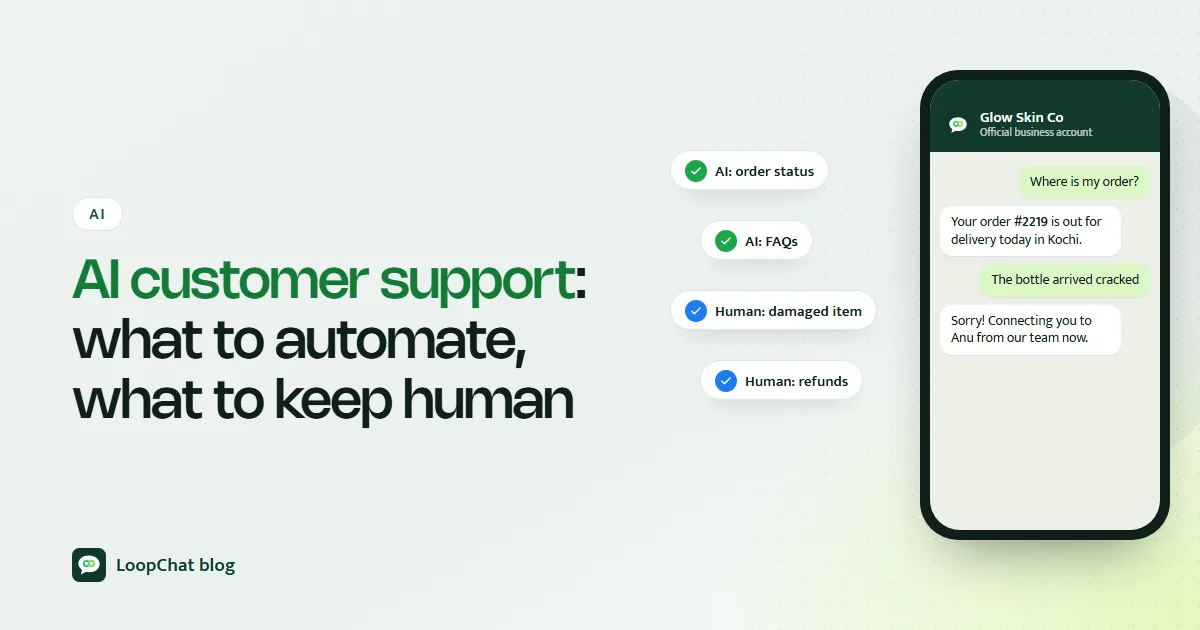
Outside that core, things change. A customer in Kochi whose order arrived with a cracked serum bottle, a wholesale buyer asking about forty units, a bride-to-be whose lehenga is stuck in transit a week before the wedding: these are not FAQ problems. They need a human who can read the situation and make a call. Good AI support knows the difference and acts on it.
Jobs AI can own end to end
These are the categories where the answer is fixed or already sits in your store data, so AI can resolve the conversation without a person.
Policy and FAQ answers
Shipping timelines, return and exchange windows, accepted payment methods (UPI, cards, COD), size charts, care instructions. You write the answer once in your business information, and the AI phrases it naturally for each customer, in English, Hindi or Hinglish, depending on how they wrote to you.
Order status
"Where is my order?" is the single most common support question for most stores, and the answer already exists in your order and fulfilment records. When the AI can look up the order, it can reply in seconds with the status and tracking link instead of a promise to check.
Proactive shipping updates
The cheapest support ticket is the one that never gets raised. Automatic messages at the moments that matter, such as order confirmed, shipped, out for delivery, and delivered, stop a large share of "any update?" messages before they start.
Straightforward returns and exchanges
For a standard case, such as a kurta that does not fit, within the return window, unused, AI can confirm eligibility, explain the steps and share the next action. Once the case stops being standard, it should stop being the AI's job.
COD order confirmation
For stores with a high share of cash-on-delivery orders, asking the buyer to confirm before dispatch is routine, rule-based work. A short confirm or cancel message filters out orders the customer never meant to receive. We cover the full method in how to reduce COD failures.
Jobs AI should hand to a person
Some conversations should reach a human even if the AI could technically produce a reply.
Upset or emotional customers. Someone who has waited ten days for a delayed parcel does not want a polished template. They want to feel heard by a person who can actually do something, whether that is a refund, a reship or a priority dispatch.
High-value or high-stakes cases. Large orders, bulk enquiries, repeat customers who spend a lot with you, and anything involving a significant refund deserve a human decision.
Unusual product problems. A defect you have not seen before, damage that does not match the courier's notes, a skin reaction after using a product, or a fit question that falls outside your size chart. These need someone who can ask the right follow-up questions and judge the specifics.
The rule of thumb: if the right answer depends on context the AI cannot see, or on a decision only your team should make, route it.
Why this is a sales question as much as a support one
In ecommerce, support is as much a conversion lever as a cost.
Before purchase, shoppers ask the questions that decide whether they buy: "Will this reach Indore by Friday?", "Is this charger compatible with my phone?", "Is this fabric see-through?" A question that sits unanswered for six hours is often a lost sale, because the shopper has moved to another tab. An instant, accurate reply keeps the intent alive.
After purchase, fast and accurate help builds the trust that brings people back, which is why service features so heavily in our guide to Shopify customer retention. That is why the routing design matters as much as the automation itself: the AI should resolve what it can quickly, and the conversations that carry real money or real risk should reach the right person fast.
The AI-first, human-backed workflow
The setup that works is neither AI-only nor human-only. It looks like this:
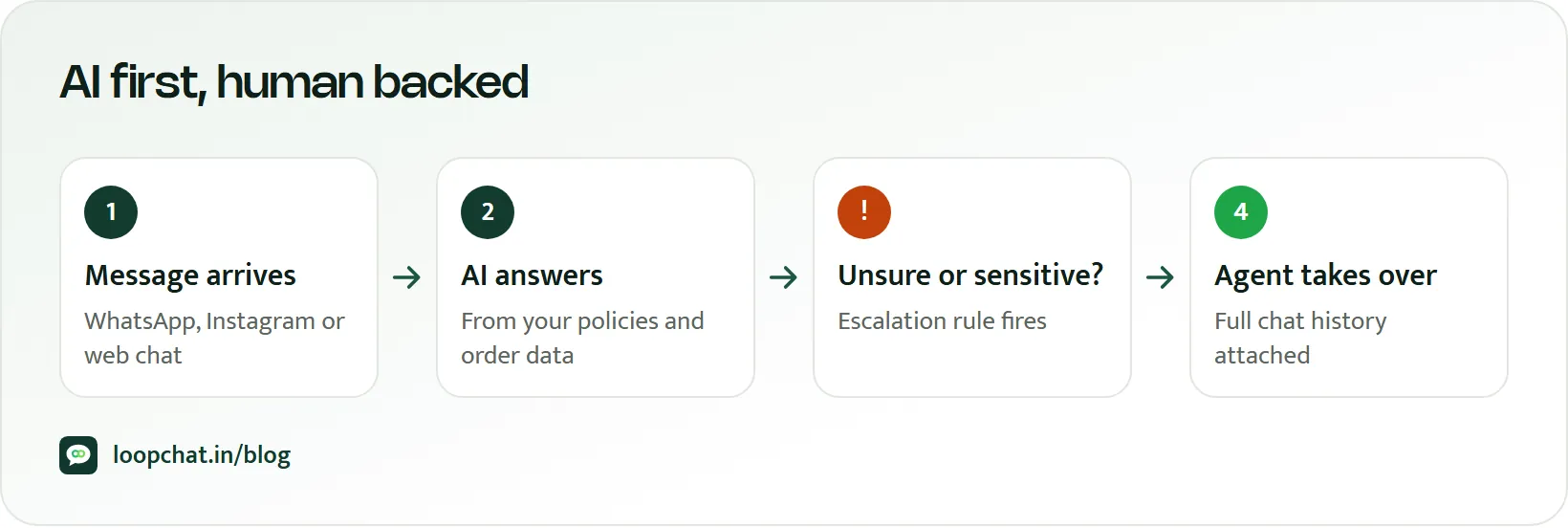
- Every incoming message reaches the AI first, around the clock.
- The AI answers routine questions straight away from your business information and store data.
- Anything it cannot answer confidently, or anything sensitive, high-value or unusual, is handed to a person.
- The person sees the full conversation history, so the customer never has to repeat themselves.
- Once the human resolves it, the conversation can go back to automation for routine follow-ups.
That handover is where a shared inbox matters. When sales and support work from the same place, a pre-sales chat that turns into a bulk order reaches the right person with context. Our guide to Shopify CRM integrations covers that support-to-sales handoff in more depth, and Shopify workflow automation shows where support routing fits among the other workflows worth automating first.
Rollout mistakes that create more tickets than they save
Letting AI close sensitive cases. An AI that confidently "resolves" a damaged-item complaint with a policy paragraph creates an angrier customer and a second, harder ticket. Ambiguous and sensitive cases should be escalated, not closed.
Hiding the human. If the path to a person is buried or missing, frustration grows quickly. On WhatsApp this is also a policy matter: the WhatsApp Business Policy says businesses that automate replies must offer prompt, clear and direct escalation paths, such as transfer to a human agent in the chat, a phone number, email, website support or a support form.
Never reviewing the answers. AI repeats whatever you taught it, at scale. If your return window changes from 7 days to 15 and nobody updates the business information, the AI will give the wrong answer hundreds of times. Review replies regularly, and always after a policy, price or shipping change.
Ignoring message costs. Automation is not free on WhatsApp. Per Meta's pricing page, as of October 2026 service messages are charged after the first 1,000 per business phone number each month, and utility messages sent inside an open customer service window are charged too. Use the WhatsApp pricing calculator to estimate costs before you switch on high-volume automation, and read our explainer on the October 2026 WhatsApp pricing change for the background.
Confusing support AI with a general chatbot. Meta's terms for the WhatsApp Business Platform restrict AI providers whose AI is the primary product on offer, and Meta decides what counts as primary. A store assistant that answers questions about your own orders and products is a very different thing from a general-purpose chatbot, but keep your AI focused on your business and never use customer data to train outside models.
A rollout checklist
- Begin with the questions that have one right answer: where is my order, delivery times, return and exchange rules, payment options and COD checks.
- Write your business information properly: policies, shipping zones and timelines, size charts, product details.
- Define explicit escalation rules for upset customers, high-value orders and unusual cases, and do not let the AI attempt them.
- Make reaching a human one tap or one phrase away, on every channel.
- Give agents the full AI conversation history at handover.
- Review AI replies on a fixed schedule, and immediately after any policy change.
- Track the pre-sales questions the AI resolves outside working hours, because that is where the conversion upside shows up.
- Check your WhatsApp message spend each month against what the automation is resolving.
For a deeper look at choosing between scripted flows and AI replies for each job, read bot flows or AI replies. If you run a Shopify store specifically, our guide on using AI to improve customer service on Shopify covers product guidance, brand voice and tone.
How LoopChat helps
LoopChat runs AI agents that answer from your business information in English, Hindi and Hinglish, inside a shared team inbox for WhatsApp, Instagram and website chat. When a conversation needs a person, handover is one click, and the agent sees the whole history. You can assign, label and add notes, so complaints and bulk enquiries reach the right teammate.
On the Sprint plan and above, LoopChat connects to Shopify and WooCommerce for COD order confirmation, order and shipping updates and abandoned checkout reminders, so many routine questions never need to be asked. Every plan includes monthly AI credits, and Meta's own message charges are billed separately. Then start a 15-day free trial or book a demo.
Sources
- Meta for Developers: Pricing on the WhatsApp Business Platform (accessed October 2026)
- WhatsApp for Business: Business Policy (accessed October 2026)
- Meta: Meta Terms for WhatsApp Business Platform (accessed October 2026)