WhatsApp Business API pricing changed on 1 October 2026: what Indian businesses need to know
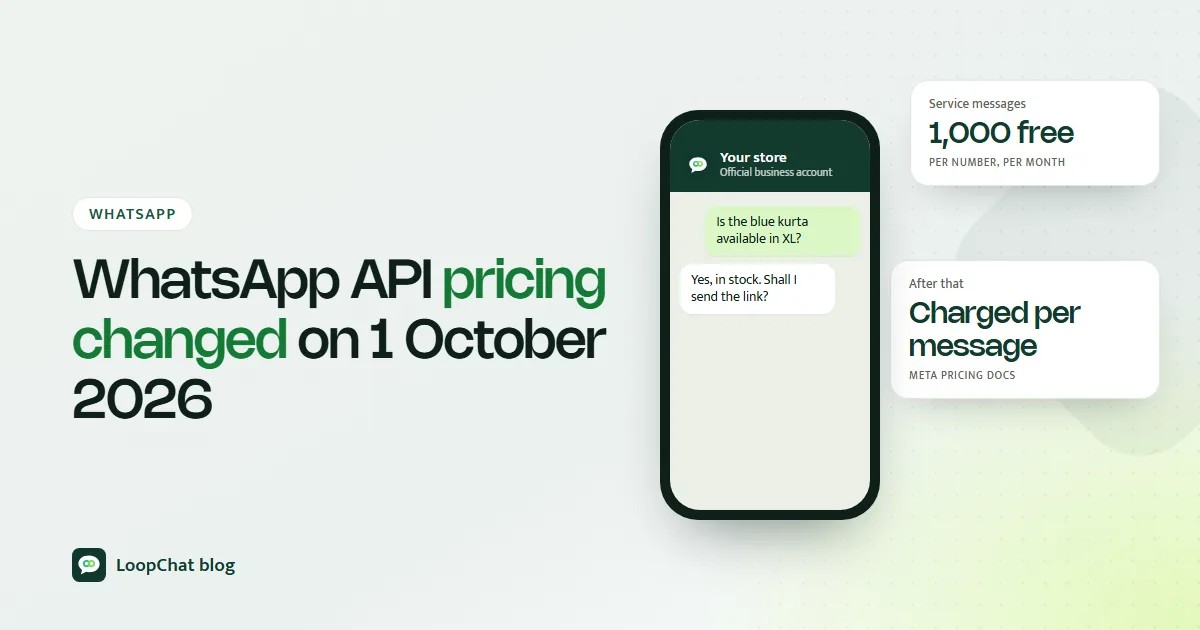
Service replies and in-window utility messages are now charged, with 1,000 free service messages a month per number. Here is how the bill works now.
Contents
WhatsApp Business API pricing changed on 1 October 2026. Two kinds of message that used to cost nothing now carry a charge: the ordinary replies a business sends while a customer conversation is open, and utility templates sent during that same open window. Each business phone number gets 1,000 free service messages a month, and marketing and authentication templates are charged as before.
Below: what changed, how the per-message model works, and how to estimate and control your Meta bill, all from Meta's developer documentation as of October 2026.
What changed on 1 October 2026
Meta announced the changes on its pricing documentation as "H2 2026" updates and they are now live. In short:
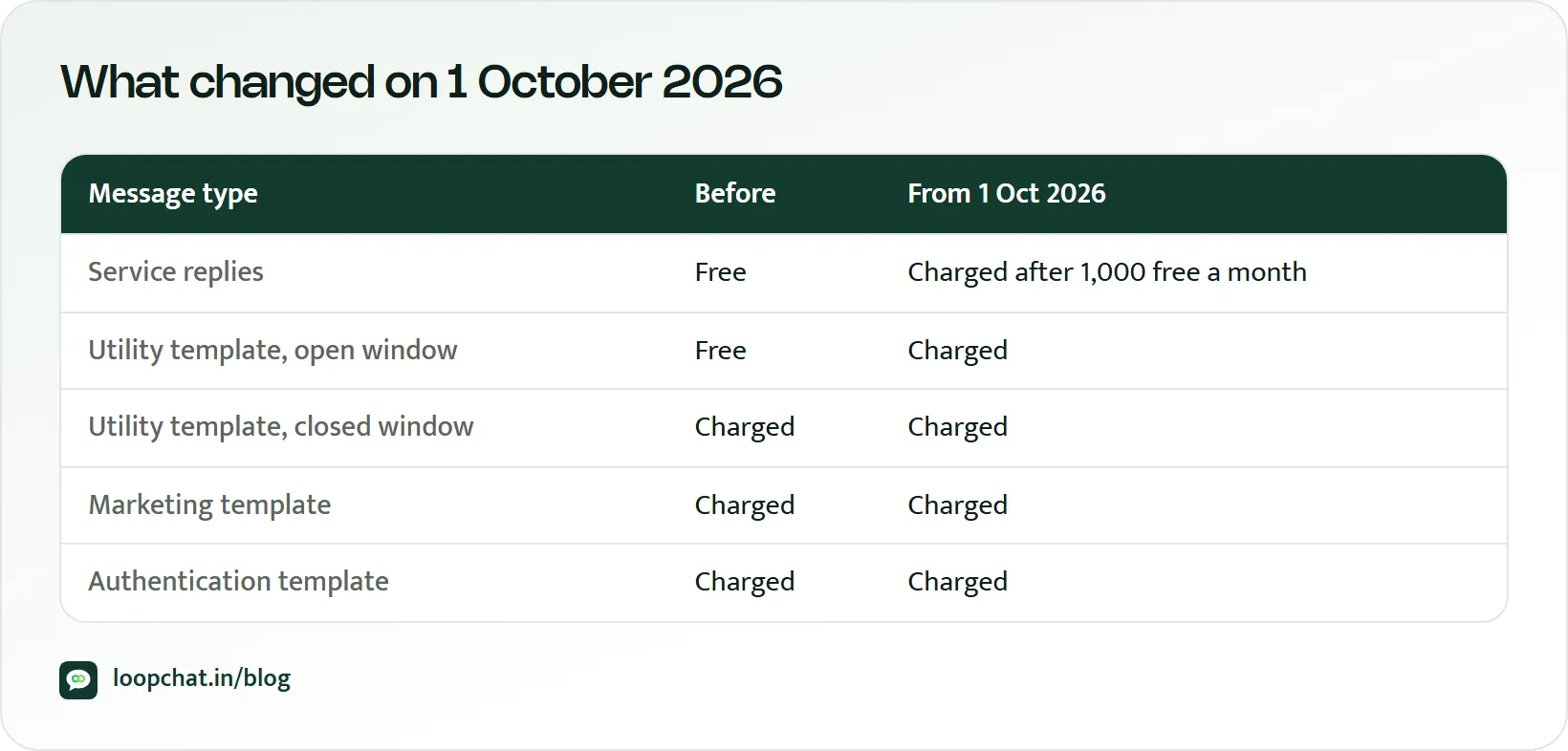
| Message type | Before 1 Oct 2026 | From 1 Oct 2026 |
|---|---|---|
| Service (non-template replies) | Free since 1 Nov 2024 | Charged per message after 1,000 free a month per number |
| Utility template inside an open window | Free since 1 Jul 2025 | Charged per message |
| Utility template outside the window | Charged | Charged (no change) |
| Marketing template | Charged | Charged (no change) |
| Authentication template | Charged | Charged (no change) |
| Meta Business Agent | Per-token billing from 1 Aug 2026 | Per-token billing |
Service replies are no longer free
A service message is any non-template message you send in reply to a customer: a text answering "Is the blue kurta available in XL?", a product image, a location pin. These became free in November 2024. From 1 October 2026 Meta charges for them per delivered message, at the published rate for the customer's country.
To soften the change, Meta gives every business phone number a free tier of 1,000 delivered service messages each month. Unused messages do not roll over, and charging starts at the 1,001st service message in that month.
One practical warning: if your Meta messaging account has no payment method on file, Meta delivers service messages only within the free tier and stops delivering them once the 1,000 are used. If your support replies suddenly stopped reaching customers in October, check the billing setup first.
Order and delivery templates sent during an open chat
Utility templates are things like order confirmations, shipping updates and COD confirmation requests. Since July 2025, a utility template sent while the customer's 24-hour window was open cost nothing. That ended on 1 October 2026. A utility template is now charged wherever it is sent, inside or outside the window.
Meta Business Agent messages and per-token billing
Meta added a fifth message category on 1 July 2026: Meta Business Agent, for replies written by Meta's own AI agent platform. Meta's documentation says per-token charging for these messages took effect on 1 August 2026, at one global rate of $2.00 per million input and output tokens (cache tokens are not charged). Meta estimates a typical message uses 20,000 to 25,000 tokens, which works out to roughly 4 to 5 US cents per message.
The distinction matters. Meta defines a service message as any non-template reply that is not powered by Meta Business Agent, whether a person types it or a third-party AI generates it. So if your chatbot or AI assistant runs on a separate AI provider, its replies are billed as service messages, and the AI provider charges you separately for its own usage.
| Meta Business Agent | Service message | |
|---|---|---|
| Who writes it | Meta's AI agent platform | Your team or a third-party AI |
| How Meta charges | Per token, one charge covering AI and delivery | Per delivered message |
| Rate | $2.00 per 1M tokens | Published rate for the customer's country |
| Free tier | None | 1,000 per number per month |
| Free in a free entry point window | No | Yes |
How WhatsApp API pricing works now
Since 1 July 2025 Meta charges per delivered message, not per conversation. Two things decide the price: the message category and the customer's country calling code. Customers are never charged for messaging you.
The five categories are marketing, utility and authentication (all templates) plus service and Meta Business Agent (both non-template). If you want a refresher on choosing the right template category, our guide to getting templates approved covers it. A verified badge does not change any of this either; our WhatsApp blue tick guide explains what the badge does and does not do.
When a customer messages you first
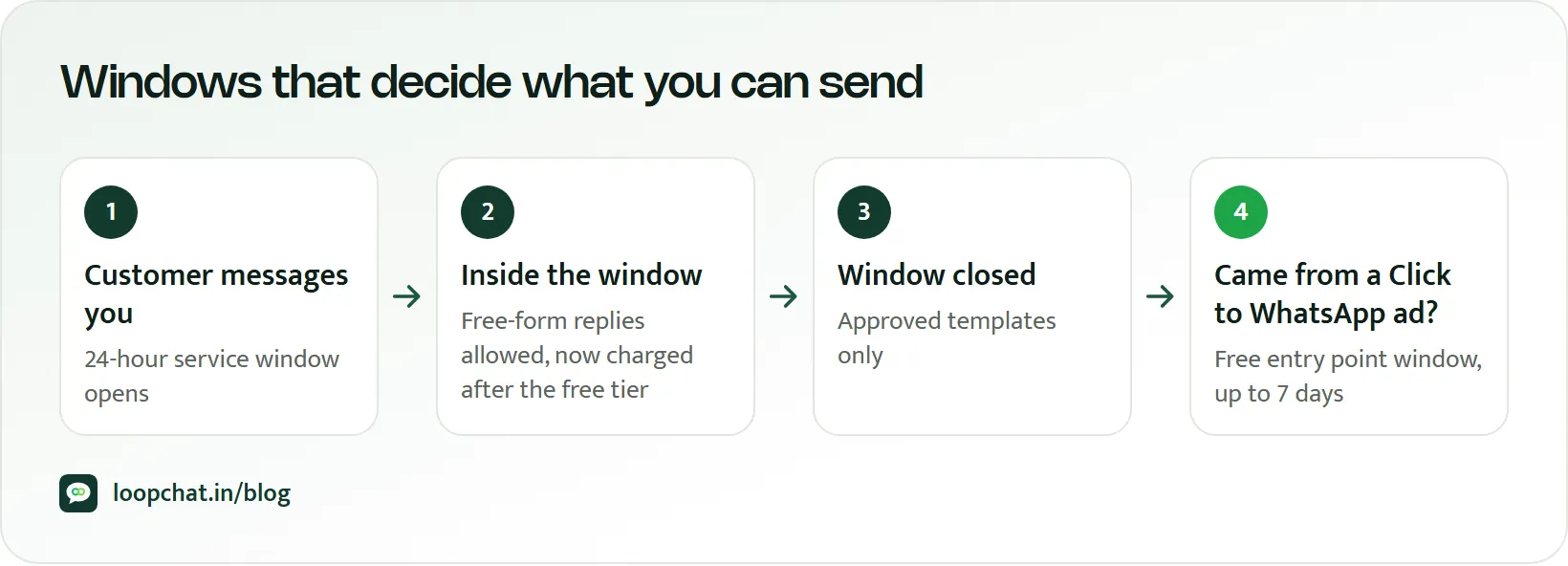
When a customer messages or calls you, a 24-hour customer service window opens. Each new message from them resets it to 24 hours. You can send non-template messages only while this window is open. Outside it, you must use an approved template.
The window still decides what you are allowed to send. What changed on 1 October is that it no longer makes replies and in-window utility messages free.
The free entry point window
There is still one fully free path. When a customer reaches you from a Click to WhatsApp ad (on the Android or iOS app) and you reply within the customer service window, a free entry point window opens. Meta's current documentation says it can stay open for up to 7 days. During it, marketing, utility, authentication and service messages are all free. Only Meta Business Agent messages are still charged.
For stores running Click to WhatsApp ads, this makes ad-sourced chats noticeably cheaper to handle than other conversations.
Rates depend on the customer's country
Meta publishes a rate card per market and category, and Indian rates are listed on Meta's WhatsApp Business Platform pricing page. Meta also publishes rates in INR. For businesses whose billing country in Meta's Billing Hub is India, Meta's documentation says all messaging accounts must move to INR billing by 31 December 2026, or Meta will stop delivering their messages from 1 January 2027.
Volume tiers, where the per-message rate drops as monthly volume rises, apply only to utility and authentication messages. Service messages do not get volume discounts.
Your WhatsApp software provider's subscription is separate from Meta's charges. Ask your provider whether it passes Meta's rates through as they are or adds a margin.
Two smaller notes. Eligible government and non-profit organisations keep free service messages beyond the free tier until 31 December 2027. And a separate pricing policy applies to "AI Providers", meaning companies offering general-purpose AI assistants on WhatsApp. It does not cover an ordinary store using AI for support.
How to estimate your WhatsApp bill now
You do not need a spreadsheet model to get close. Work through it per phone number:
- Open Meta's rate card and note the Indian rates for service, utility and marketing (and authentication if you send OTPs).
- Pull last month's volumes from your inbox or WhatsApp Manager: service replies, utility templates (both inside and outside the window), and marketing templates.
- Subtract 1,000 from service replies for the free tier, and leave out anything sent inside a free entry point window.
- Multiply each remaining count by its rate.
- Add your software subscription.
You can also estimate your bill with our WhatsApp pricing calculator. If you collect prepaid orders by UPI, review UPI merchant charges alongside your messaging costs.
Practical ways to keep the bill in check
Write fewer, fuller replies. A single message with the size chart, price and a buy link costs less than four fragments. Train agents to answer completely the first time, which also means fewer follow-up questions.
Put structured steps in one place. Address collection, size selection or return requests can run as a WhatsApp Flow, a form inside the chat, instead of a long back-and-forth.
Answer repetitive questions automatically and accurately. An AI agent that resolves "Where is my order?" in one reply is cheaper than a human who needs three. Our post on bots versus AI replies covers when each fits.
Trim your automated sequences. A COD flow that sends a confirmation request, a reminder and a second reminder is three utility charges. Often one clear message with buttons works as well, as our guide to reducing COD failures shows.
Keep low-value notices on cheaper channels. Email or SMS can carry newsletters. Save WhatsApp for moments where a fast reply changes the outcome: a customer in Indore asking about delivery before paying, a COD confirmation, a cart reminder. When you do send marketing templates, target the people most likely to want them; our guide to running your first broadcast campaign explains why that also protects your quality rating.
Answer ad-sourced chats fully. Inside the free entry point window, those replies cost nothing.
A short checklist for October and after
- Confirm a payment method is on file for every Meta messaging account, so service messages keep delivering past the free tier.
- Plan your move to INR billing before 31 December 2026 if your billing country is India.
- Check October's charges by category against last month's volumes.
- Review any automation that sends several utility templates in a row.
- Find out whether your AI replies run through Meta Business Agent or a third-party AI, so you know which pricing applies.
Frequently asked questions
Are WhatsApp service messages still free?
Not fully. From 1 October 2026 Meta charges per delivered service message, but each business phone number gets 1,000 free service messages per month. Those do not roll over, and charging starts at the 1,001st.
Are utility templates free inside the 24-hour window?
No longer. They were free inside an open customer service window from July 2025 until 30 September 2026. From 1 October 2026 they are charged per message.
What does Meta Business Agent cost?
Meta charges $2.00 per million input and output tokens, with one charge covering both AI processing and delivery. Meta estimates this is about 4 to 5 US cents for a typical message. It is charged even inside a free entry point window.
Is anything still completely free?
Yes. Messages from customers to you are never charged. Inside a free entry point window opened by a Click to WhatsApp ad, marketing, utility, authentication and service messages are free. And the first 1,000 service messages per number each month are free.
Where do I find the Indian rates?
On Meta's WhatsApp Business Platform pricing page, which lists rates by market and category and offers INR rate cards.
How LoopChat helps
LoopChat runs on the official WhatsApp Business Platform (Cloud API). Its shared inbox lets your team answer WhatsApp, Instagram and website chats in one place, and its AI agents reply from your business information in English, Hindi and Hinglish, with one-click handover to a person. Answering properly the first time keeps your message count down.
Broadcasts, the no-code flow builder and Shopify and WooCommerce automations (cart reminders, COD confirmation, order updates) let you decide how many messages each journey sends. Meta's charges are separate from our plans. You can start a 15-day free trial or book a demo.
Sources
- Meta for Developers: Pricing on the WhatsApp Business Platform (accessed October 2026)
- Meta for Developers: Upcoming pricing updates for Meta Business Agent, service and utility messages (accessed October 2026)
- Meta for Developers: Pricing policy for AI Providers on the WhatsApp Business Platform (accessed October 2026)
- WhatsApp Business: Platform pricing and rate cards (accessed October 2026)